Content Idea Brainstormer: 10 Ready-to-Film Ideas for Any Niche in Seconds
Coming up with good ideas is the hardest part of being a creator. The Content Idea Brainstormer turns Claude or ChatGPT into a content strategist that generates 10 distinct ideas spanning 6 idea types: evergreen tutorials, trending formats, personal stories, hot takes, behind-the-scenes, and educational deep dives. Each idea comes with a working title, the specific angle, and a performance rationale — ready to draft from immediately.
Every creator knows the feeling: you have a video to make, you sit down to figure out what it should be, and 45 minutes later you're reading a Reddit thread about something completely unrelated, no closer to a decision. Coming up with ideas sounds like the easy part until you're the one doing it consistently, week after week, for a channel that expects you to show up.
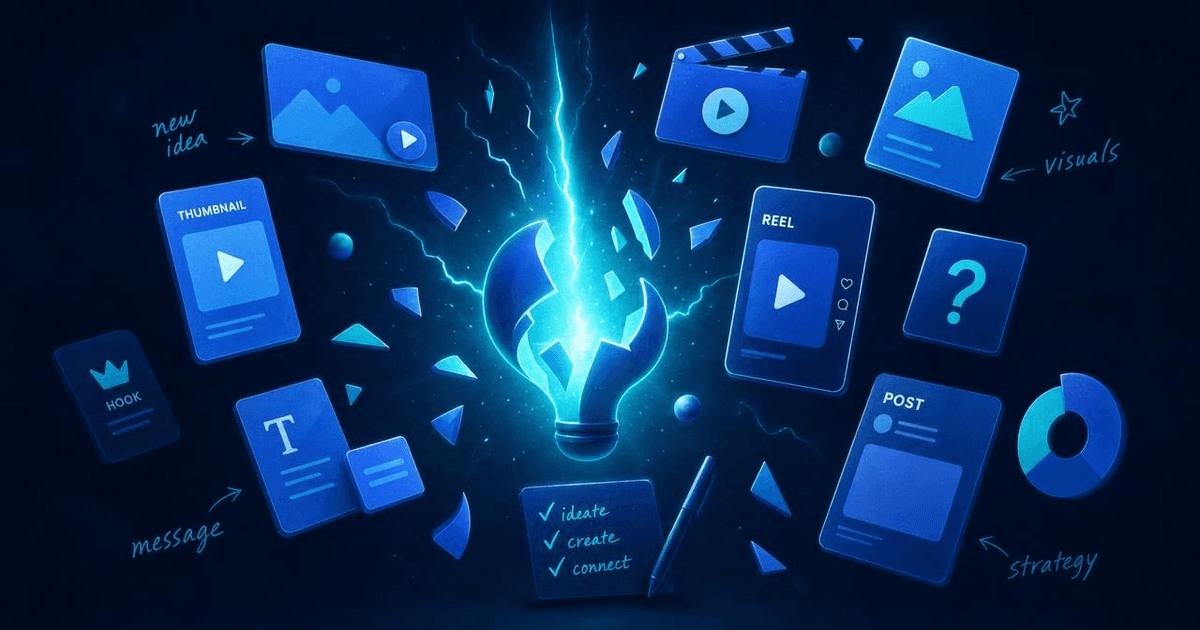
The Content Idea Brainstormer is a free installable AI skill for Claude and ChatGPT that solves this problem directly. Give it your niche, a description of your audience, and any relevant constraints — and it generates 10 specific, ready-to-film ideas in one shot. Not vague topics, but ideas with working titles, the specific angle that makes them interesting, and the reason each one is likely to perform.
It runs in under two minutes and leaves you with enough ideas to fill two weeks of your upload schedule.
The 6 Idea Types the Skill Generates
The Content Idea Brainstormer doesn't generate 10 of the same type of idea — it deliberately spans 6 distinct formats so your content mix stays varied and reaches different segments of your audience.
1. Evergreen Tutorial
Content that stays discoverable and relevant for years, not weeks. Evergreen tutorials are typically search-driven — someone types a question into YouTube, finds your video, gets the answer. They're the foundation of sustainable channel growth because they keep driving views long after upload.
What the skill generates for this type: a specific topic in your niche that people are consistently searching for, a title framed as a problem or question (which performs better in search than declarative titles), and the unique angle that makes your version worth watching even if ten other tutorials already exist on the same topic.
2. Trending Format
Surface area between what's already getting views across the platform and your specific niche. The skill identifies formats and topics currently generating momentum — a news event, a viral challenge, a format being applied across different niches — and maps it to your content area. The window for trending format content is short (usually 1–2 weeks before saturation), so the skill flags these as time-sensitive and explains why.
3. Personal Story
The type of content that no other creator can replicate, because it happened to you. Personal story ideas are generated around a specific experience, mistake, realization, or behind-the-scenes moment from your creator journey or niche expertise. The skill generates the angle and working title — but the content itself is entirely yours.
Why this type performs: specificity is the difference between a personal story that resonates and one that feels generic. The skill prompts for concrete details: not "my first year as a creator" but "the month I almost quit, what happened right before, and the one comment that changed my mind." The more specific, the more universal the resonance tends to be.
4. Hot Take
An opinionated position on something your audience debates, thinks about, or takes for granted — delivered as a clearly arguable stance. Hot take ideas are engineered for comments and shares: people who agree share it, people who disagree comment on it, and both drive algorithmic reach.
The skill generates a working title in the "unpopular opinion" or "I was wrong about X" format that signals the take is coming, the specific position to argue, and two or three counterarguments to acknowledge (which makes the take feel credible rather than inflammatory).
5. Behind-the-Scenes
Process content — how you make what you make, how your workflow has evolved, what your setup looks like, what a typical day actually involves. Behind-the-scenes content builds audience trust and parasocial investment in a way that polished tutorial content doesn't.
The skill generates behind-the-scenes ideas calibrated to your specific niche and format. A gaming channel's BTS content looks different from a cooking channel's — the skill understands that and generates ideas that fit your category, not generic "day in my life" concepts.
6. Educational Deep Dive
High-value, high-trust content that demonstrates genuine expertise on a specific topic within your niche. Deep dives are longer content typically, require more research, but build authority disproportionately. A channel that has three or four excellent deep dives is trusted differently by its audience than a channel of the same size that only posts lighter content.
The skill generates deep dive ideas with a scope that's wide enough to be comprehensive but narrow enough to be completable — avoiding the "complete guide to everything" trap that produces unfocused content nobody finishes.
The Three Criteria for a Filmable Idea
Before generating the 10 ideas, the skill applies a filter. An idea only makes the list if it clears three criteria:
1. Clear audience. There is a specific person who will find this valuable, and you can describe who they are. "Anyone interested in photography" fails this test. "Beginner photographers who've bought their first mirrorless and are frustrated that their photos don't look like what they see in the viewfinder" passes it. The audience clarity determines whether the idea has natural searchability and whether it can be angled correctly.
2. Specific enough to be differentiated. The idea is positioned with a specific angle — not just a topic, but a take on a topic. "Best editing software for beginners" is a topic. "Why I switched from Premiere to DaVinci Resolve after 3 years (and the one thing Premiere still does better)" is a differentiated angle on the same topic. The skill won't generate a topic without an angle.
3. You can speak to it credibly. The idea falls within your expertise, your experience, or your audience's understanding of what you cover. An idea that requires you to fake expertise or cover a topic outside your positioning is a trap — it generates one video but damages long-term audience trust.
Title and Angle Output
Each of the 10 ideas includes two things beyond the idea itself:
Working title: specific enough to draft from immediately. Not a placeholder — a real title that could go into your upload if you made the video today. The title is chosen for the format it performs best in (search-optimized for evergreen, clickable for trending, emotionally resonant for personal story).
The angle: one sentence that explains what makes this specific take on the topic interesting versus the alternatives that already exist. This is the most important output from the skill. "How to do keyword research for YouTube" as a topic has 40,000 competing videos. "How to do keyword research for YouTube when your channel is too small for any keyword to work — the approach I used to get my first 10,000 views" has almost none, and it's a more interesting answer to the same question.
The angle is what separates an idea you can actually make from a vague topic that produces mediocre content.
Performance Rationale
The skill tells you, briefly, why each idea is likely to perform — and distinguishes between different types of performance so you can make an informed choice about what to make.
Some ideas are strong on search (consistent views over a long time horizon, low initial burst). Some ideas are strong on algorithm (high CTR, high watch time, good for homepage recommendations). Some ideas are strong on shareability (the type of video that gets texted to someone or posted in a Discord). And some ideas are evergreen-versus-time-sensitive — the skill flags when an idea has a window and when it's safe to schedule further out.
This rationale isn't a guarantee — it's the reasoning behind why the skill generated the idea. You know your audience better than any AI does, and the performance rationale gives you the information to evaluate the idea against what you know actually works on your channel.
How to Run It Repeatedly
The Content Idea Brainstormer works best as a sprint tool — run it weekly, with a slightly different constraint or context each time, to maintain variety and creative freshness. A few ways to keep the output varied:
Constraint-based prompting:
"Generate 10 ideas based on my last 4 uploads. Don't repeat formats I've done recently. Here's what I made: [list]."
Trend-anchored session:
"What's trending in [niche] right now that I could make content about this week? Generate 10 ideas that capture current momentum."
Audience-first session:
"My most engaged subscriber segment asks a lot of questions about [specific topic]. Generate 10 ideas specifically for that sub-audience."
Constraint mode:
"Generate 10 ideas I could film in one take, no editing required — just me talking to camera for 5–10 minutes."
The skill adapts the output based on how you constrain the prompt. Running it the same way every week produces diminishing returns; varying the input keeps the ideas varied.
How to Use It
The Content Idea Brainstormer is free and installs as a Claude skill or ChatGPT Custom Instruction. Basic usage:
"I make content for [describe your niche and audience]. I post [frequency] on [platforms]. Generate 10 content ideas for my next two weeks of uploads."
Add more context for better results:
"I make content for intermediate home cooks who want restaurant-quality results without professional equipment. I post twice a week on YouTube. My most popular videos are about technique (not recipes). Generate 10 ideas — avoid recipe videos, focus on skills and methods."
Pricing and Where to Get It
The Content Idea Brainstormer is free. Works in Claude and ChatGPT — install it once and use it every time you're planning your content calendar.
→ Get the Content Idea Brainstormer
Pair It With
- Blog Post Outline Generator — once you have your ideas, this skill builds the complete structure for any that you want to turn into long-form written content.
- Content Repurposing Planner — plan how each idea can produce content across multiple platforms, not just one video.
- Video to Everything Repurposer — after you film the idea, this skill turns the video into a full week of social content.
Get More Skills Like This
The Content Idea Brainstormer is part of the Content Machine — a curated set of 28 AI skills for high-output creators who need to produce more without burning out. If you want the full output system — ideation, scripting, repurposing, and analytics — the bundle saves you 85% vs buying each skill individually.
The blank upload schedule problem isn't a creativity problem. It's a system problem — you don't have a reliable way to generate good ideas quickly. The Content Idea Brainstormer installs that system in 30 seconds and runs it in two minutes. What you do with the ideas is still entirely up to you.
About the author
Content, CreatorSkills
The CreatorSkills team publishes practical guides on AI workflows for content creators.
About CreatorSkills