Blog Post Outline Generator: From Keyword to Full Outline in Minutes
The blank page problem in blogging isn't usually a writing problem — it's a structure problem. Creators who know their topic well enough to write about it still stall when they sit down because the outline doesn't exist yet. The Blog Post Outline Generator for Claude and ChatGPT takes a keyword or topic and produces a complete working outline: three title options, a search intent classification, every H2 with its H3 sub-points, proof ideas for each section, internal link anchors, and a CTA block. This guide covers what each component does and why the structure produces posts that rank.
The blank page problem in blogging is rarely a knowledge problem. Creators who are deep in their niche, who have been making content for years, who genuinely know the subject — they still stall when they sit down to write. Not because they don't know what to say. Because they don't know where to start, which order to put things in, or how much depth any given section actually needs.
That stall is a structure problem. And it costs more than time: most creators who skip outlining write posts that meander, bury the point, make a big claim without supporting evidence, and end without directing the reader anywhere. A post that takes three hours to write from an empty page can take 45 minutes to write from a solid outline.
The Blog Post Outline Generator is a free skill for Claude and ChatGPT that solves the structure problem before you write a word. Give it your keyword and target audience — get back a complete working outline: three title options, a search intent classification, every H2 with H3 sub-points, proof ideas for each section, internal link anchor suggestions, and a CTA block.
Here's what each component does and why it's there.
Title Generation
The skill generates three title options for every topic, each targeting a different search intent and content format:
The Listicle Title — "7 Blog Post Structures That Get Traffic on Page One." Listicles signal a clear value exchange: a specific number of things the reader can skim, evaluate, and apply. They consistently outperform narrative titles for click-through in search results because the number is a concrete commitment — the reader knows exactly what they're getting.
The How-To Title — "How to Write a Blog Post in 2026 (With an Outline That Actually Works)." How-to titles capture people mid-problem: they're searching for a method, not a concept. These perform best when the reader is stuck on something specific and wants a process, not an opinion.
The Curiosity Gap Title — "The Blog Post Outline That Most SEO Writers Skip (and Why It Costs Them Traffic)." Curiosity gap titles are strongest for newsletter audiences, social clicks, and non-search traffic. They promise insider information — something the reader doesn't have — which drives clicks from people who weren't actively searching.
What makes a strong blog title versus a weak one: specificity in the implicit promise. "How to Write a Blog Post" is a weak title — the implicit promise is enormous and vague. "How to Write a 1,500-Word Blog Post Outline in 20 Minutes" is strong — the implicit promise is narrow, measurable, and realistic. Readers convert because they believe the specific promise; they bounce because the vague promise didn't hold up.
Keyword placement in blog titles follows the same rule as YouTube: the primary search term goes in the first three to four words, before any modifier. "Blog Post Outline Generator: Complete Guide" front-loads the keyword. "Complete Guide to the Blog Post Outline Generator" buries it.
Search Intent Mapping
Before the outline is built, the skill classifies the post's search intent. This determines the H2 architecture — because different intent types require different structural logic.
Informational intent — The reader wants to understand something. They're not ready to buy, and they're not looking for a comparison. Posts with informational intent need to build understanding progressively, section by section. The H2 flow moves from "what is it?" to "why does it matter?" to "how does it work?" to "common mistakes" to "when to use it."
Navigational intent — The reader is trying to find a specific resource, tool, or page. These posts are usually short, direct, and answer one question. Structure is simple: "here's what you're looking for, here's how to access it, here's what to do next."
Commercial intent — The reader is evaluating options before a purchase decision. These posts are comparisons, reviews, and "best X for Y" lists. The H2 structure needs a comparison framework, a clear criteria section, and a verdict with recommendation. Each option needs the same depth of coverage to feel credible.
Transactional intent — The reader is ready to act and wants to know how. These are "how to buy," "how to sign up," "how to set up" posts. Structure prioritizes steps over explanation — numbered H2s with no detours.
Most AI outline generators skip intent classification and produce the same structure for every post. A comparison post written with an informational structure will cover the topic without ever making a recommendation — which is exactly what commercial-intent readers need and never get. The skill classifies intent first, then builds the outline accordingly.
H2/H3 Architecture
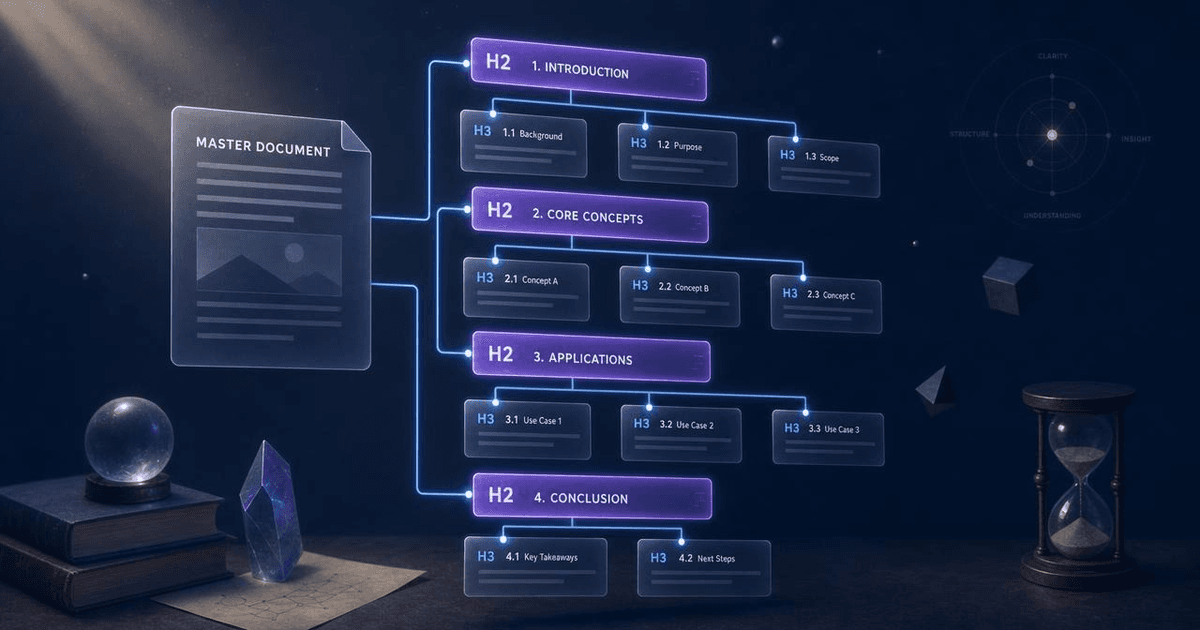
Every H2 in the outline has a specific job: it proves, demonstrates, or answers one thing. Not two. Not a related cluster of things. One.
The test: if you remove an H2 section entirely, does the reader miss something they needed to understand the rest of the post? If the answer is no — if the post works fine without that section — the section is filler. The skill doesn't write filler H2s.
H3 sub-points exist to support the H2's main point with specifics. For a tutorial post, H3s are the individual steps within a phase. For a comparison post, H3s are the evaluation criteria applied to each option. For an informational post, H3s are the examples, edge cases, and nuances that make the H2's claim credible.
The progression across H2s follows what the skill calls the reader's understanding curve: the first H2 meets the reader where they are, the middle H2s build their understanding section by section, and the final H2 before the CTA lands the insight they came for. A post that delivers its central idea in the second H2 has nowhere to go — readers who get what they came for early leave without converting.
Proof Ideas
For every H2, the skill includes a proof suggestion: what evidence, example, or data point the section needs to be credible.
This is the piece most creators skip when outlining because it requires knowing in advance what you'll need to find. But posts without proof fail in a specific way: they make large claims with nothing to back them up. Readers recognize the pattern immediately — the writing sounds confident, but nothing in the post makes them believe it. They leave without converting, and they don't come back.
Proof types the skill recommends:
Statistics and data — A number from a study, survey, or platform that supports the H2's claim. The bar for credibility here is specificity: "studies show that X" is not a data point. "A 2025 HubSpot survey of 1,200 content marketers found X" is a data point.
Before/after examples — A specific person or account that experienced the change the section describes. Real examples outperform hypothetical ones every time.
Screenshots or visuals — For SEO posts, tutorial posts, and reviews, the suggestion to include a screenshot of the thing being described prevents the common mistake of writing about something the reader has to imagine.
Personal experience — When data isn't available or would feel forced, the creator's own experience is the proof. The requirement is specificity: not "I've tried this and it works" but "when I applied this to my post on email marketing, time-on-page went from 1:45 to 3:20 over the next three weeks."
The proof suggestions are not written copy — they're a note to the writer about what to find or write for each section. They prevent "big claim, no evidence" writing before the draft starts.
Internal Link Anchors
Internal linking — linking from one post on your site to another — is one of the most underused SEO levers in creator content. Every internal link passes authority from the linking page to the linked page, helps search engines understand your content structure, and keeps readers on your site instead of leaving after one post.
The skill suggests internal link placements for every post outline: which H2 would naturally reference another piece of content, what that content should be about, and what anchor text to use.
Anchor text matters for SEO: "click here" and "learn more" are weak anchors that communicate nothing to search engines. "Here's how to structure a TikTok script for maximum retention" is a strong anchor — it tells search engines what the linked page is about and gives readers a reason to click.
The link suggestions are placeholders — the skill recommends what type of content to link to, and you fill in the actual URL when you publish. If the content doesn't exist yet, the outline has just identified a content gap worth filling.
The CTA Block
Every post should make the reader do something. The skill generates a CTA recommendation based on your stated funnel goal for the post.
Email opt-in — For posts where the primary goal is list growth, the CTA connects the post's topic to a lead magnet that deepens the value. "Want the full outline template as a Google Doc? [Download it here]." The lead magnet must be specifically related to the post — a generic "sign up for my newsletter" following a specific tutorial post converts at a fraction of the rate.
Product or skill purchase — For posts that are solving a problem the product directly addresses, the CTA names the specific transformation. Not "check out my shop" but "if you want to build your full content calendar in one session rather than writing posts individually, the Content Repurposing Planner does this in under an hour."
Related post — For posts where the reader needs more depth before they're ready to convert, the CTA sends them deeper into your content. The related post recommendation in the outline is never arbitrary — it's the logical next step in the reader's understanding.
Social follow — For posts where awareness is the primary goal and the reader has no existing relationship with the creator, a platform-specific follow CTA is the right next step.
How to Use It
Open your Claude or ChatGPT project with the skill installed. Give it your keyword or topic, your target audience, and your CTA goal for the post. The more context you give — the specific angle you want to take, what your audience already knows, what misconceptions you want to address — the more targeted the outline.
You'll get three title options, a search intent classification, a full H2/H3 structure with proof suggestions and internal link anchors, and a CTA block. The outline is ready to draft from section by section — no more blank page.
Pricing and Where to Get It
The Blog Post Outline Generator is free with email registration. Works in Claude and ChatGPT — paste your keyword and audience, get a complete structured outline in minutes.
→ Get the Blog Post Outline Generator
Pair It With
- Content Repurposing Planner — Once the post is live, the repurposing planner turns it into a thread, a newsletter section, a short-form script, and social captions — without rewriting from scratch. The blog post becomes the anchor content; the repurposing planner extends its reach.
- Lead Magnet to Paid Product Ladder Builder — The outline will identify a CTA, and if that CTA is a lead magnet, this skill builds the resource itself and maps the ladder from free download to paid offer.
Get More Skills Like This
The Blog Post Outline Generator is part of the Content Machine — a curated set of 28 AI skills for high-output creators who need to produce more without burning out. If you're producing written content alongside video or social and want the full output system, the bundle saves you 85% vs buying each skill individually.
Structure is the thing that separates a post that takes three hours and meanders versus a post that takes 45 minutes and builds to a clear point. The Blog Post Outline Generator does the structure work in minutes so the writing time can be spent on the one thing AI can't do for you: your actual insight.
About the author
Content, CreatorSkills
The CreatorSkills team publishes practical guides on AI workflows for content creators.
About CreatorSkills