TikTok Script Template: Hooks, Pacing, and Comment-Driving CTAs in Minutes
TikTok is the most unforgiving platform for slow scripts: every second of dead air costs you viewers. The TikTok Script Template skill builds short-form scripts with TikTok-native pacing — fast hooks, information-dense beats, on-screen text cues, and comment-driving CTAs — across 15, 30, and 60-second formats. This guide covers the hook types, the pacing structure, why on-screen text matters for muted viewers, and how to write CTAs that actually drive comments.
TikTok is the only platform where a one-second difference in hook delivery can be the difference between 200 views and 200,000. Every frame matters. Every word costs time you don't have.
Most creators spend 20–40 minutes writing a script for a video that will run 30 seconds. They agonize over the opening, write the body section in a rush, and tack on a generic "follow for more" at the end. The result is a script that looks fine on paper but feels padded when recorded — and TikTok's algorithm sees the retention drop-off in the first three seconds and stops pushing it.
The TikTok Script Template is a free skill for Claude and ChatGPT that changes that workflow. Give it your topic, audience, and target length, and you get a complete TikTok-native script: a hook calibrated for scroll-stopping, a body structured for zero dead air, on-screen text callouts for muted viewers, and a CTA designed to drive comments rather than passive follows.
Here's exactly how each part works.
The Hook (First 2 Seconds)
TikTok's algorithm makes its initial push decision based on how many people watch past the first three seconds. If your hook doesn't work, the rest of the video doesn't matter — it will never reach enough people to find out.
The skill selects from five proven hook types based on your topic and audience:
The Curiosity Gap — Opens an information loop the viewer needs to close. It promises a payoff without revealing the answer. "You've been saving your TikTok drafts wrong and it's costing you views." The viewer stays to find out how.
The Bold Statement — Stakes a position that sounds surprising or even wrong, then earns it in the next few seconds. "The best TikTok videos don't have good hooks. They have specific ones." This type works in niches where common advice is genuinely flawed.
The Reaction Hook — Opens mid-emotion: surprise, disbelief, frustration. You respond to something before introducing it. "Wait — you're charging clients how much for this?" It drops the viewer into the middle of something happening, which creates immediate context.
The Visual Surprise — Opens on something unexpected in frame: an unusual juxtaposition, a dramatic before/after moment, something that makes no sense until the caption explains it. The hook happens in the image, not in the words.
"I Did X and Here's What Happened" — The accountability hook. Results-first storytelling that starts with the outcome, then rewinds to the method. "I posted on TikTok every day for 30 days. Here's the number that surprised me." The viewer watches to find out what the number was.
The skill selects the best hook type for your content and writes the opening line verbatim. It reads the hook out loud before finalizing — if it doesn't sound natural spoken, it doesn't survive.
Script Body Pacing
TikTok rewards information density. Every second of video that doesn't add value, move the story forward, or increase tension is a second a viewer might leave. The skill structures the body with this constraint in mind.
Three standard formats, each with a different internal beat structure:
15-Second Format — Hook (0–2s) → single core idea delivered fast (2–12s) → CTA (12–15s). There is no room for setup, context, or backstory. The idea has to land immediately, and it needs to be one idea only. Two ideas in 15 seconds guarantees neither lands.
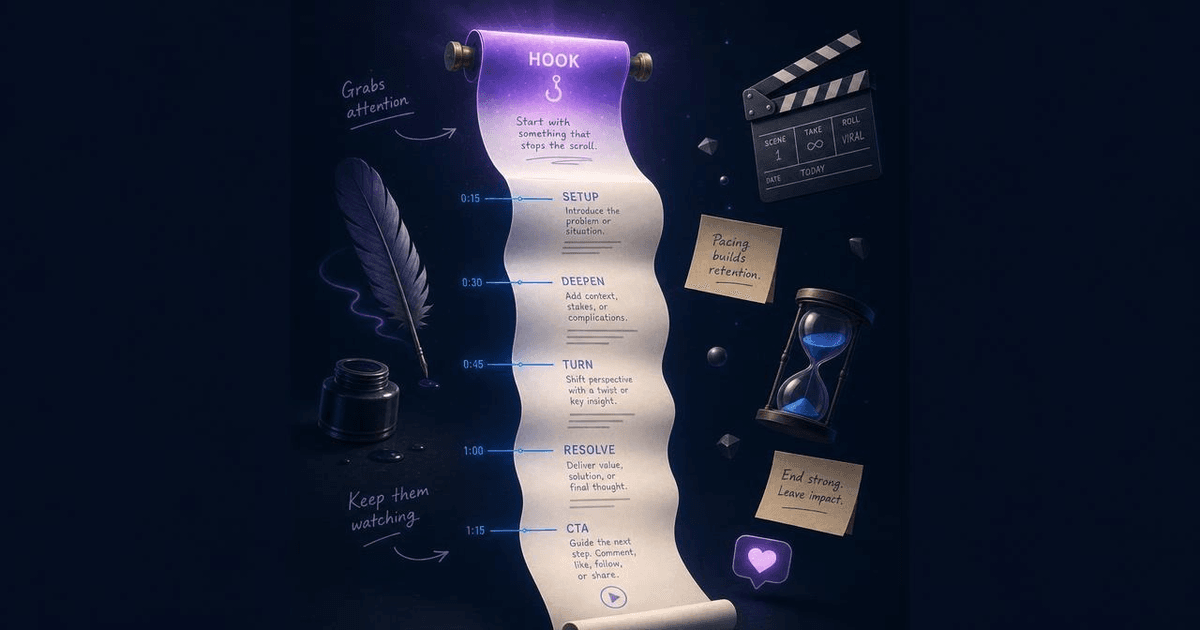
30-Second Format — Hook (0–2s) → tension or setup (2–8s) → three fast beats or steps (8–24s) → payoff and CTA (24–30s). The middle section is where most scripts die — the beats need to be self-contained and forward-moving. Each one should make the viewer more curious about the next.
60-Second Format — Hook (0–3s) → setup or problem (3–10s) → three to five content beats with natural transitions (10–50s) → conclusion + CTA (50–60s). At 60 seconds you have room for a slightly richer structure, but the discipline is the same: no filler, no circling back, no "anyway, the point is."
Between every beat, the script includes a micro-transition — a line that bridges from one point to the next without pausing. "And then it gets worse." "But here's the part nobody talks about." "That's not even the biggest problem." These one-line transitions keep retention high by continuously raising the stakes or the payoff of what's coming.
On-Screen Text
Approximately 85% of TikTok is watched without sound — either because the viewer is in public, commuting, or has their phone set to silent. If your script only delivers value through spoken audio, you're losing most of your potential audience before they ever hear a word.
The skill outputs specific on-screen text callouts with timing for every script. These aren't generic subtitle instructions — they're independent copy that adds information beyond what's being said aloud.
The rule: on-screen text should complement spoken copy, not duplicate it. If the voiceover says "here's the mistake most creators make," the on-screen text doesn't say the same thing. It says the name of the mistake before the voiceover reveals it — which creates a brief curiosity loop even for viewers watching without sound.
Each callout includes:
- The exact text to display
- The timestamp window (e.g., "3–7s")
- Suggested placement (top-left, bottom-third, centered)
- Whether it appears all at once or word by word
Text reveals that roll in word by word consistently outperform static text blocks in A/B tests for the same content — the progressive reveal mimics the experience of reading something and pulls the eye.
Comment-Driving CTAs
"Follow for more" is the lowest-performing CTA on TikTok. It asks for a commitment (a follow) from a viewer who has known you for 30 seconds, in exchange for a vague promise (more content). The conversion rate is poor, and more importantly, it generates no comments.
Comments are among the highest-value engagement signals TikTok's algorithm weighs. A video with strong comments gets more distribution than a video with the same view count and no comments. The skill writes CTAs specifically designed to generate comments rather than passive follows.
The framework: a specific question that the viewer already has an opinion on, requires one sentence or less to answer, and makes them feel like their experience is the point.
Poor CTA: "Follow me for more TikTok tips." Strong CTA: "Tell me in the comments — how long did your first TikTok script take you to write?"
Poor CTA: "What did you think? Let me know below." Strong CTA: "Drop a 1 if this is still happening to you and a 2 if you've finally fixed it."
The number-drop CTA consistently outperforms open questions because it removes the effort of thinking of a response. It also lets the creator read the comment split in real time, which provides useful audience data.
The skill generates three CTA options for every script and identifies which is most likely to drive comments based on the video's topic and audience.
Caption and Hashtag Output
TikTok captions are searchable. They function like YouTube descriptions — the algorithm uses them for indexing and discovery. The skill writes a caption of 100–150 characters that reinforces the hook, includes the primary keyword naturally, and doesn't repeat the on-screen text or spoken hook word-for-word.
Hashtag output includes five to eight tags organized by size tier: two to three broad category tags for indexing signal, two to three mid-size tags where the video has a real chance of ranking, and one to two niche tags specific to the video's exact topic. The specific niche tags are where new accounts actually get discovered.
How to Use It
Open your Claude or ChatGPT project where you've installed the skill. Then give it:
- Your topic (specific beats better than vague — "why TikTok's algorithm hides your first video" beats "TikTok algorithm tips")
- Your audience (who they are, what they care about, what frustrates them)
- Your target length (15, 30, or 60 seconds)
- Any visual context you have (talking head, voiceover with B-roll, text-only)
You'll get a complete script with hook, body beats, on-screen text callouts, CTA options, caption, and hashtags. Read it out loud before you film. If any line feels clunky when spoken, flag it — the skill can revise specific lines while keeping the structure.
Pricing and Where to Get It
The TikTok Script Template is free with email registration. Works in Claude and ChatGPT — you get a complete TikTok-native script across 15, 30, and 60-second formats.
→ Get the TikTok Script Template
Pair It With
- Instagram Reels Script Writer — Same short-form structure adapted for Reels, which rewards slightly more polish and longer captions than TikTok — useful when you're cross-posting or running separate platform-specific campaigns.
- Content Repurposing Planner — Once you've produced a TikTok that performs, the repurposing planner tells you how to extend it into Shorts, Reels, a newsletter section, and a thread — without re-scripting from scratch.
- Short-Form Video Producer — The full production system: visual framing, audio suggestions, shooting notes, editing pacing, and platform export specs alongside the script, for creators who want a complete pre-production package rather than a script alone.
Get More Skills Like This
The TikTok Script Template is part of the Content Machine — a curated set of 28 AI skills for high-output creators who need to produce more without burning out. If you're publishing across platforms and want a faster, more systematic content operation, the bundle saves you 85% vs buying each skill individually.
TikTok is won in the first two seconds and sustained with a system. A script that accounts for muted viewers, front-loads the value, and ends with a question that makes people want to respond is the foundation that most creators skip in the rush to just start filming. The TikTok Script Template builds that foundation in minutes instead of an hour.
If you want the broader short-form strategy — hook testing, trend-jacking, platform-specific optimization — How to Make Viral Short-Form Content with AI covers the full system.
About the author
Content, CreatorSkills
The CreatorSkills team publishes practical guides on AI workflows for content creators.
About CreatorSkills