YouTube Chapter Generator: Timestamped Chapters That Boost Retention and Search
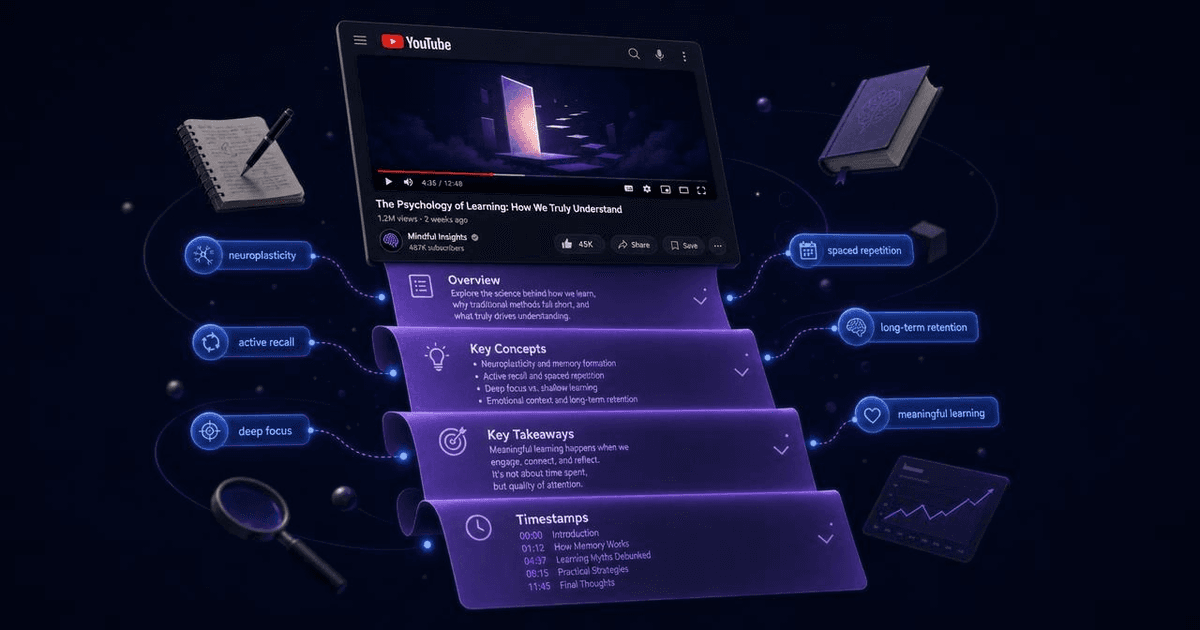
Most creators skip YouTube chapters because manual timestamping is tedious — and that skip leaves retention and search visibility on the table with every upload. The YouTube Chapter Generator turns a transcript, outline, or description into properly formatted chapters in under two minutes, with SEO-optimized titles and chapter breaks placed at meaningful transitions rather than arbitrary time intervals. This guide covers why chapters matter for the algorithm, YouTube's technical requirements, and how to title chapters for search.
Manual timestamping is tedious enough that most creators skip it. They upload the video, fill in the description, and move on. YouTube chapters get added "later" — and later usually doesn't come.
That skip costs you more than it seems. YouTube indexes chapter titles as searchable content. Chapters appear as clickable previews in Google search results for video queries. Viewers who use chapters to navigate stay on the video longer than viewers who drop off when they can't find the section they want. And the retention spike that happens at every chapter start — when a viewer jumps to a new section — signals quality to the YouTube algorithm.
The YouTube Chapter Generator is a free skill for Claude and ChatGPT that eliminates the friction. Paste your transcript, outline, or even just a rough description of what the video covers — get back properly formatted, SEO-optimized chapter timestamps in under two minutes.
Here's how it works and what to know before you use it.
Why Chapters Matter for YouTube Growth
The case for chapters goes deeper than convenience.
YouTube indexes chapter titles as searchable content. When you add "How to Remove the Background in Photoshop" as a chapter title, YouTube treats that phrase as a keyword associated with your video — separately from the main title and description. A video on advanced Photoshop techniques can surface in search results for "remove background Photoshop" because of a chapter title, even if the main title doesn't include that phrase.
Chapters appear as visual previews in Google search. When someone searches a video-intent query on Google, results often include horizontal thumbnail previews of individual chapters. Your video can occupy multiple positions in a Google results page — one for the overall video and one or more for specific chapters — giving you more real estate than competing videos without chapters.
Navigation reduces bounce rate. A viewer who arrives at a 20-minute tutorial and can't immediately find the specific section they need will leave. A viewer who sees "Setting Up Your First Campaign — 4:30" in the description and jumps straight there stays. YouTube's definition of a bounce is leaving the video in the first 30 seconds — chapters functionally prevent that.
Chapter starts create retention spikes. Every time a viewer jumps to a new chapter, it registers as a new watch session start within YouTube's analytics. A video with multiple chapters will show bumps in the retention curve at each chapter start — and retention spikes above the average signal to the algorithm that viewers are actively engaged and finding specific value, not just passively watching.
YouTube's Technical Requirements
This is where most creators run into trouble when adding chapters manually. YouTube's chapter system breaks if any of these rules are violated, and when it breaks, no chapters appear at all — including the valid ones.
0:00 is required. The very first chapter must be at 0:00. If it starts at 0:01 or later, YouTube won't render chapters. This trips up creators who start their first timestamp with the first "real" section of the video — YouTube requires you to name the opening, even if it's just the video intro.
Minimum three chapters. Two timestamps in the description are not enough. YouTube requires at least three to activate chapter navigation.
Each chapter must be at least 10 seconds long. If you have a chapter that's only five seconds, YouTube won't display any chapters from that video. The minimum exists to prevent chapter spam.
Formatting is exact. Timestamps must appear in the description with a space or line break after each one. The accepted format is 0:00 Chapter Name or 00:00 Chapter Name. YouTube reads these automatically — there's no separate tool to input them. The description is the only place they go.
No duplicate timestamps. Two chapters at the same timestamp cancel each other out and can break the entire chapter system.
The YouTube Chapter Generator outputs timestamps pre-checked against all five requirements. If your transcript has a segment that would create a chapter shorter than 10 seconds, the skill either merges it with an adjacent chapter or flags it for you to review.
Chapter Title Optimization
The single biggest mistake creators make with YouTube chapters is writing titles that describe the content rather than the value.
Weak chapter title: "Introduction"
Strong chapter title: "Why Most Tutorials Get This Wrong"
Weak: "Part 2"
Strong: "The Setting That Changes Everything"
Weak: "Q&A Section"
Strong: "Your Top 5 Questions Answered"
The principle: every chapter title should tell a viewer what they'll understand, be able to do, or know by the end of that segment — not just label what's in it. "Introduction" communicates nothing and has zero search value. A title that includes a keyword phrase the video actually answers is both more useful for navigation and more valuable for YouTube's indexing.
For SEO, the skill identifies two to three keyword opportunities per video based on the transcript and places them in chapter titles where they appear naturally. The keyword placement follows the same logic as title optimization: front-load the phrase, be specific over broad, and don't sacrifice clarity for keyword density.
Example: video on starting a podcast in 2026
Without optimization:
- 0:00 Intro
- 2:15 Equipment
- 8:30 Recording
- 14:00 Editing
- 21:00 Publishing
- 26:30 Q&A
With optimization:
- 0:00 What This Video Covers
- 2:15 Podcast Equipment for Beginners (Under $200)
- 8:30 Recording Your First Episode Without a Studio
- 14:00 Editing in Audacity — The Only Settings You Need
- 21:00 How to Publish on Spotify and Apple Podcasts
- 26:30 Common Mistakes to Avoid
The second set contains four keyword phrases YouTube will index, creates meaningful previews for each section, and gives a viewer enough information to jump to exactly the part they need.
Where to Place Chapter Breaks
Chapter breaks placed at arbitrary time intervals (every 5 minutes, every 10 minutes) are less effective than chapter breaks placed at meaningful transitions. The chapter system exists to help viewers navigate — and viewers navigate at points where the content topic actually changes.
For tutorials: break at each distinct step or phase. "Step 1 — Gather Your Ingredients" and "Step 2 — Set Up Your Workstation" are better than "First 5 Minutes" and "Next 5 Minutes."
For interviews: break at topic changes, not time intervals. If the guest spends eight minutes on their origin story and then pivots to their current strategy, that pivot is where the chapter break goes — not at minute five.
For listicles: each list item gets its own chapter. "3 Tools I Use Every Day" becomes three chapters with timestamps for each tool. Viewers who want to skip to the third item should be able to.
For reviews: break at the natural review structure — first impressions, specifications, performance test, final verdict. These transitions are already in the content; chapters make them navigable.
The skill reads your transcript or outline and identifies meaningful transitions automatically. For transcripts, it looks for topic pivots, transition language ("next," "now let's talk about," "moving on to"), and explicit segment markers. For outlines, it uses the H2/H3 heading structure directly.
The Output Format
Every output is ready to paste directly into the YouTube description box. No additional formatting, no reformatting step.
0:00 What This Video Covers
2:15 Podcast Equipment for Beginners (Under $200)
8:30 Recording Your First Episode Without a Studio
14:00 Editing in Audacity — The Only Settings You Need
21:00 How to Publish on Spotify and Apple Podcasts
26:30 Common Mistakes to Avoid
The skill also flags any technical violations before delivery — so if 0:00 is missing, a chapter would be shorter than 10 seconds, or duplicate timestamps are present, you see the issue before pasting. No troubleshooting after upload.
How to Use It
Open your Claude or ChatGPT project with the skill installed. Paste your transcript, video outline, or a description of what the video covers — in whatever form you have it. Tell the skill the total video length so chapter placement can be validated.
You'll get back a formatted chapter list ready to paste into the description, plus brief notes on any SEO keywords placed in titles and any chapters it adjusted for technical compliance.
Pricing and Where to Get It
The YouTube Chapter Generator is free. Works in Claude and ChatGPT — paste your transcript or outline, get back properly formatted, SEO-optimized chapters ready to paste into your description.
→ Get the YouTube Chapter Generator
Pair It With
- YouTube Video Description Writer — Write the full description alongside the chapters. The description skill handles the hook sentences, keyword placement, links, and CTA; the chapter generator handles the timestamps. Together they produce a complete, publish-ready description block.
- YouTube SEO System — The SEO system covers all four YouTube growth levers (search, click-through, retention, analytics). If you want to go deeper than chapter titles into full keyword strategy, title optimization, and the monthly analytics review, this is the companion.
- Analytics Translator — Once chapters are live, retention spikes at chapter starts are a signal worth reading. The Analytics Translator turns YouTube Studio data into specific decisions — including what your chapter-level retention patterns are telling you about your content structure.
Get More Skills Like This
The YouTube Chapter Generator is part of the YouTuber Starter Pack — a curated set of 26 AI skills for YouTubers covering titles, thumbnails, scripts, and analytics. If you're building a YouTube channel and want every production piece covered, the bundle saves you 86% vs buying each skill individually.
View the YouTuber Starter Pack →
YouTube chapters take under two minutes to generate. They add search value, improve navigation, keep viewers on the video longer, and create algorithmic signals every creator wants. The only reason to skip them is friction — and the YouTube Chapter Generator removes that friction entirely.
About the author
Content, CreatorSkills
The CreatorSkills team publishes practical guides on AI workflows for content creators.
About CreatorSkills