AI Monetization Strategy for Creators: Build Multiple Revenue Streams in 2026
The creators winning in 2026 aren't just making content—they're building businesses with multiple revenue streams. Here's how AI skills help you plan and execute a monetization strategy that actually works.
You hit 10,000 subscribers. Brands start emailing. You think: "Finally, I can quit my day job."
Then you do the math. A $1,500 sponsorship every other month. AdSense paying $200-400 monthly. You're looking at $15,000-20,000 per year—not exactly "quit your job" money.
Here's what successful creators know: the revenue isn't in the views. It's in the business model. (For help landing those brand deals in the first place, see how to land brand deals as a creator.)
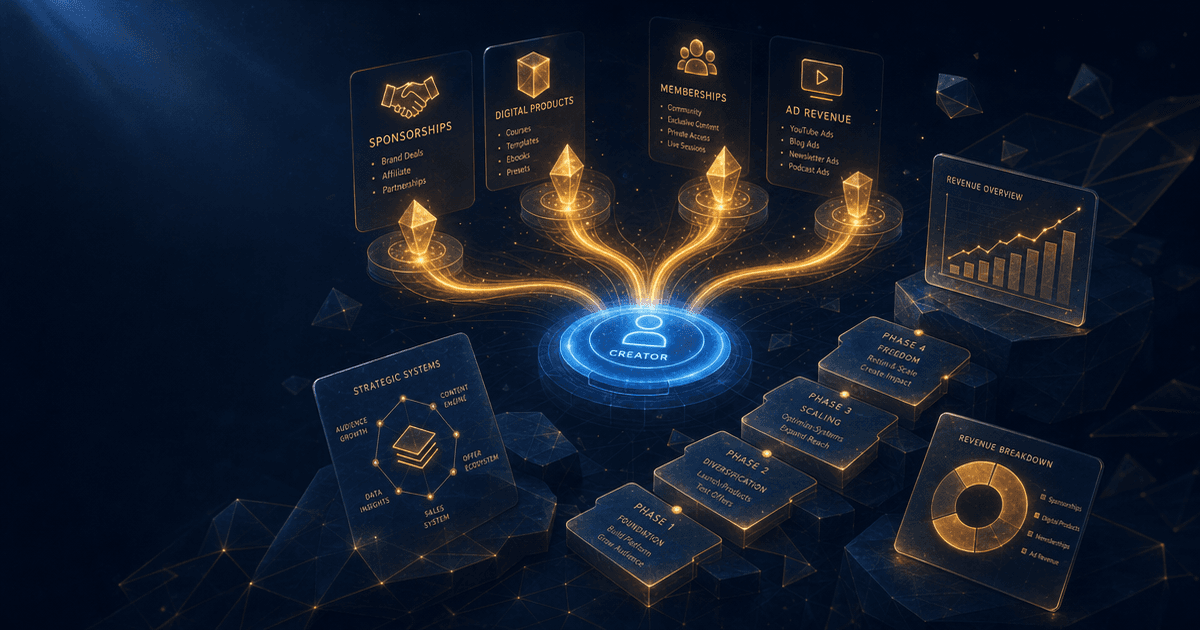
The creators earning $100K+ in 2026 don't have bigger audiences. They have better monetization stacks—3-6 revenue streams working together, with each one supporting the others. One sponsorship deal funds a digital product launch. That product builds an email list. That list becomes a course waitlist. The course customers become consulting clients.
AI skills can help you build this system. Not by "generating passive income" (which doesn't exist), but by removing the guesswork from which revenue streams make sense for your specific situation.
The creator monetization reality check
Before planning your revenue, understand the actual numbers:
YouTube AdSense pays $3-40 per 1,000 monetized views depending on your niche. A tech channel with 50,000 monthly views might earn $1,500-2,500. A gaming channel with the same views earns $400-800.
Sponsorships generally start at $10-25 per 1,000 subscribers for dedicated videos. A 50K channel might charge $500-1,250 per integration. But inbound deals don't arrive until you're consistently getting 10K+ views.
Digital products (templates, guides, presets) convert at 1-3% of engaged viewers. Price them at $19-49, and 5,000 engaged followers could generate $100-750 per product launch.
Courses convert at 1-3% of your email list. A 1,000-person list might yield 10-30 customers at $97-297 each—$970-8,910 per launch.
Memberships convert 1-5% of your active audience. At $5-15/month, 50,000 YouTube subscribers might yield 500-2,500 members—$2,500-37,500/month.
The pattern: no single stream covers your bills until you're massive. But 4-5 streams at smaller scales stack into real income.
Why most creators pick the wrong revenue streams
The common mistake: copying whatever successful creators in your niche are doing.
A 500K subscriber tech YouTuber might earn $30K/month from sponsorships. That doesn't mean you should prioritize sponsorships at 10K subscribers. Different stages, different math.
Another mistake: trying to launch everything at once. Courses, merch, memberships, sponsorships—each requires systems, time, and audience trust. Spread yourself across six half-built streams and you have six mediocre income sources.
The third mistake: ignoring your audience's actual spending behavior. A channel with 85% viewers aged 13-17 has different monetization options than one with 80% viewers aged 28-45. Teen audiences don't buy $500 courses. They might buy $12 presets or support via memberships.
How AI skills fix the monetization planning problem
The Monetization Strategy Planner skill works like a business advisor who knows creator economics inside and out.
Instead of generic "start a Patreon" advice, it builds a phased plan based on:
- Your current audience size and engagement
- Your niche and content format
- Your time constraints (solo creator vs. with team)
- Your audience demographics and buying behavior
- Your existing assets (email list, community, expertise)
The output: a specific roadmap telling you which revenue streams to activate now, which to prepare for next quarter, and which to ignore entirely based on your situation.
Phase 1: Foundation (Months 1-3)
Every creator starts here, regardless of size. These are the revenue streams with the lowest barriers and fastest activation.
Stream 1: Platform-native ads
YouTube AdSense requires 1,000 subscribers + 4,000 watch hours (or 10M Shorts views). Podcast advertising typically needs 5,000+ downloads per episode.
The skill calculates realistic projections based on your current numbers. If you're at 800 subscribers, it shows you exactly how many more views you need to hit the threshold—and whether the eventual payout justifies the effort toward monetization vs. growth.
Stream 2: Digital products
This is the fastest path to non-platform income. A $29 template or guide can be created in a weekend and sold through Gumroad or your own site.
The skill identifies what to sell based on what your audience already asks for. If commenters constantly ask "what software do you use?" or "how do you edit your thumbnails?"—there's your first product.
Stream 3: Affiliate links
Low effort, passive once set up. The skill recommends affiliate programs specific to your niche (Amazon Associates for physical products, software referral programs for SaaS/tools) and identifies which existing content should have affiliate links added.
Phase 2: Expansion (Months 4-6)
Once you have baseline revenue and an email list growing, add streams that require more setup but higher payouts.
Stream 4: Sponsorships
Brands start inbound outreach around 10K followers, but the skill shows you when you're actually ready. It calculates what to charge based on your engagement rate, niche CPMs, and audience quality—so you don't underprice yourself.
The Sponsor Deal Calculator companion skill generates rate cards, pitch templates, and helps you evaluate whether deals actually make sense vs. distracting from content.
Stream 5: Courses or workshops
Courses require more upfront investment—plan 20-40 hours to create a solid mini-course. The skill recommends when to launch based on email list size and validates demand before you build anything.
Rule of thumb: don't build a course until you have 1,000 email subscribers or have pre-sold at least 10 copies. The skill checks these criteria before recommending course development.
Stream 6: Consulting or services
High-revenue but time-intensive. The skill evaluates whether your expertise is sellable and recommends pricing ($100-500/hour depending on authority).
Consulting is positioned as a bridge to scalable products, not a long-term strategy—unless you genuinely enjoy the work.
Phase 3: Diversification (Months 7-12)
Established creators (100K+ followers) should have 4-6 active revenue streams with no single stream exceeding 40% of income.
Stream 7: Memberships or subscriptions
Patreon, YouTube Memberships, or paid newsletters. The skill calculates realistic conversion rates (1-5% of active audience) and helps you design tiered offerings that justify monthly costs.
The key insight: memberships work best when the audience wants more access/exclusivity, not just more content. The skill identifies whether your audience fits this profile.
Stream 8: Licensing or syndication
For creators with high-quality evergreen content—education, music, photography, B2B. The skill evaluates whether your content has licensing potential and identifies likely buyers.
Stream 9: Merchandise
Print-on-demand (Spring, Teespring) has zero upfront cost but thin margins ($3-15 per item). Most creators sell merch to 0.1-0.5% of their audience.
The skill only recommends merch when you have:
- 25,000+ followers
- Strong community identity (inside jokes, catchphrases)
- Existing audience engagement
The revenue stacking principle
The most successful creators don't treat revenue streams as separate silos. They stack them:
Example: Tech Tutorial Channel
- Free YouTube content builds audience
- Tutorial mentions template/tool (affiliate link)
- Video description links to free guide (email capture)
- Email sequence nurtures subscribers
- Course launch to email list
- Course buyers become consulting clients
- Consulting insights inform future YouTube content
Each stream feeds the next. The AI skill maps these dependencies so you're building a system, not isolated income sources.
Risk management: The 40% rule
The skill applies a critical rule: no single revenue stream should exceed 40% of total income.
If YouTube AdSense is 70% of your revenue, you're one algorithm change away from a crisis. If one brand sponsor pays 60% of your income, you're vulnerable to their budget cuts.
The skill flags revenue concentration risks and recommends diversification priorities.
Platform risk mitigation
What happens if YouTube demonetizes your niche? If TikTok gets banned? If Instagram changes its algorithm?
The skill always recommends building an email list—regardless of stage. Email is the only audience you truly own. Every monetization plan includes "grow email list" as a foundational step because it reduces platform dependency.
Sample monetization roadmap
Here's what the skill might output for a 25,000-subscriber educational creator:
Current state:
- 25K YouTube subscribers
- 15K monthly views
- No email list
- Zero revenue
Phase 1 (Months 1-3): Foundation
- Activate: AdSense (currently earning ~$450/month), digital product ($29 template), affiliate links
- Build: Email list (target: 500 subscribers)
- Target revenue: $800-1,200/month
Phase 2 (Months 4-6): Expansion
- Activate: Sponsorships (target: $800-1,500/deal, 2 deals/quarter), mini-course ($79)
- Grow: Email list to 1,500
- Target revenue: $2,500-4,000/month
Phase 3 (Months 7-12): Diversification
- Activate: Memberships ($7/month tier), consulting ($150/hour, 5 hours/month)
- Scale: Full course launch ($197, quarterly)
- Target revenue: $6,000-10,000/month
Month 12 projection:
- AdSense: $450
- Digital products: $800
- Sponsorships: $2,500
- Courses: $3,000
- Consulting: $750
- Memberships: $1,500
- Total: $9,000/month ($108K/year)
Conservative estimate: $72K/year. Optimistic: $140K/year.
What the skill won't do
The Monetization Strategy Planner won't:
- Promise passive income (nothing is passive—it all requires work)
- Recommend get-rich-quick schemes
- Ignore your time constraints
- Suggest courses before validating demand
- Pretend sponsorships are realistic at 500 subscribers
It will give you realistic numbers, specific timelines, and actionable next steps based on where you actually are—not where you hope to be.
Getting started
To use the Monetization Strategy Planner, gather:
- Current subscriber/follower counts per platform
- Monthly views or listens
- Audience demographics (age range, geography if known)
- Current revenue (even if $0)
- Hours per week you spend on content
- Your financial goals (supplemental income vs. full-time replacement)
The skill builds your personalized roadmap in under 10 minutes.
The bottom line
Making money as a creator isn't about finding the "right" revenue stream. It's about building the right stack of streams for your specific situation—and timing each activation so you're not overwhelmed.
AI skills remove the guesswork from which streams to pursue and when. You get a data-backed plan instead of copying whatever worked for a creator in a different niche at a different stage.
The creators earning real money in 2026 aren't guessing. They have systems.
Ready to build your monetization plan? Try the Monetization Strategy Planner or browse the complete skill library for tools that support every revenue stream. Want to validate the workflow before paying for anything? Start with our free AI skills — several cover newsletter conversion, sponsor outreach, and audience research. For the broader workflow that supports all these revenue streams, see our AI content creation workflow guide.
About the author
Founder, CreatorSkills
Caleb Leigh is the founder of CreatorSkills and helps creators build sustainable income through smart monetization strategies.
Read the founder profile