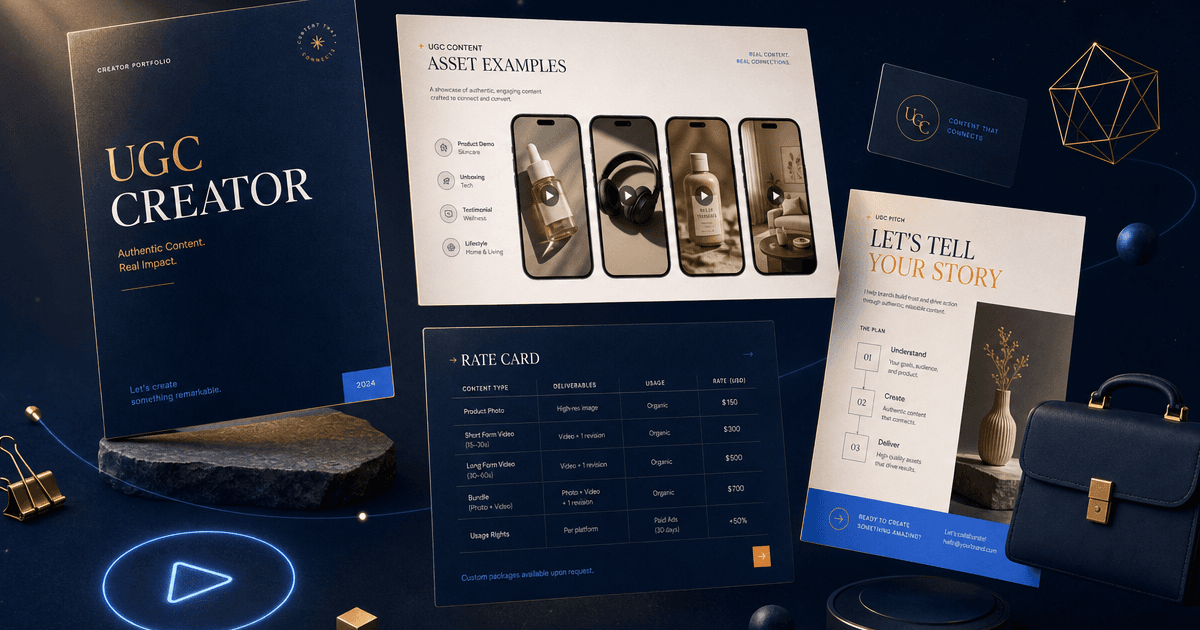
How 5 UGC Creators Use AI to Land Brand Deals
You don't need 100K followers to get paid for product content. These 5 UGC creators prove it — and they use AI to do the hard parts faster.
Brand deals do not require a massive audience. That is the first thing most creators get wrong.
In UGC — user-generated content — brands buy the video asset, not your follower count. A creator with 3,000 TikTok followers who makes sharp product content can charge the same per video as someone with 300,000. The difference is not reach. It is how you pitch, what you show, and how you price.
The creators who win are building systems. They use AI to build portfolios that look professional, write pitches that get replies, and calculate rates that do not leave money on the table. Below are five real archetypes — the exact workflows they use, the AI skills that power them, and what you can copy today.
1. The Skincare Micro-Creator: Building a Portfolio From Products She Already Owns
The creator: 8K TikTok followers, posts GRWM and product review content. The goal: Land her first paid skincare deal without waiting for brands to notice her.
Most new UGC creators make the same mistake: they wait for a brand to send free products before filming anything. This creator did the opposite. She filmed four portfolio assets using products already on her bathroom shelf — a moisturizer she used for six months, a face wash she repurchased twice, and a sunscreen she genuinely recommended to friends.
She used the [UGC Creator Portfolio Kit](https://creatorskills.co/skills/ugc-creator-portfolio-kit?utm_source=blog&utm_medium=organic&utm_campaign=blog_cta_retail_2026&utm_content=how-ugc-creators_ugc-creator-portfolio-k to structure each asset:
- Product showcase — 20 seconds of texture, packaging, and application
- Before/after — 30 seconds showing skin texture improvement over four weeks
- Lifestyle integration — 45 seconds of her morning routine, product in context
- Testimonial — 30 seconds talking to camera about why she repurchases
The AI skill gave her a shot list for each format, lighting tips for her iPhone and ring light setup, and a portfolio page layout. She hosted the videos on a simple Notion page with a rate card below — no website required.
The result: She pitched three skincare brands with her portfolio link and landed her first $200 video deal in five days. The brand did not ask for her follower count once.
2. The Fitness Creator: Calculating Rates That Match His Quality
The creator: 15K Instagram Reels, posts workout content and supplement reviews. The goal: Raise his rate from $75 per video to $250 without losing clients.
He had done eight paid deals at $75 each and knew he was undercharging. The problem: he had no framework for what the market actually pays. He guessed based on what other creators posted in Facebook groups — which meant he was pricing from vibes, not data.
He used the [Sponsor Deal Calculator & Pitch](https://creatorskills.co/skills/sponsor-deal-calculator?utm_source=blog&utm_medium=organic&utm_campaign=blog_cta_retail_2026&utm_content=how-ugc-creators_sponsor-deal-calculator to break down pricing by:
- Asset type (30-second video vs. 60-second vs. carousel)
- Usage rights (organic only vs. paid ad usage)
- Exclusivity (can he work with competing brands in the same month?)
- Content quality (professional lighting and editing vs. raw phone footage)
The skill showed him that creators with his production quality and niche typically charge $200–$400 for a 30-second video with organic usage rights. For paid ad usage — which most fitness brands need — the range is $350–$800.
He sent a rate increase email to his two repeat clients, citing the new asset pricing and offering a monthly retainer at a slight discount. Both accepted. One moved from per-video to a $900/month retainer for four videos.
3. The Food & Lifestyle Creator: Writing Pitches That Open With Product Use
The creator: 5K TikTok followers, posts cooking hacks and kitchen gadget reviews. The goal: Land deals with food brands without sending generic "I love your products" DMs.
Generic outreach gets ignored. Brands receive hundreds of "I'd love to collaborate" messages per week. The creators who get replies open with something specific — a genuine observation about the product, a content idea, or a piece of social proof.
This creator used AI to write pitches that started with product use, not compliments. For a spice brand she wanted to work with, her pitch opened like this:
"I used your garlic chili crisp on eggs this morning and filmed a 20-second clip of the texture on camera. The hook is: 'This is the only condiment I buy in bulk.' My audience asks about it every time I post a cooking video. I'd love to create a full UGC asset for you — here is my portfolio and rate card."
The AI skill helped her:
- Find the right contact at each brand (marketing manager vs. influencer coordinator)
- Structure the email so the portfolio link appears above the fold
- Write a 3-day follow-up that does not sound desperate
- Attach a rate card formatted as a clean PDF
She sent seven pitches. Four replied. Two turned into paid deals within two weeks.
4. The Tech & Gadget Creator: Creating Mockups That Sell the Concept
The creator: 12K YouTube Shorts, posts unboxings and gadget reviews. The goal: Pitch a headphone brand with a concept mockup before they commit to a deal.
Some brands need to see what you will make before they pay. This is especially true in tech, where product angles, lighting, and editing style matter. Instead of pitching with words alone, this creator used AI to generate a concept mockup — a script + storyboard for a 45-second unboxing video.
He used an AI skill to:
- Write a script with three hook variations
- Generate a shot list (close-up of packaging, peel reveal, first listen reaction)
- Create a simple storyboard with frame descriptions
- Estimate production time and delivery schedule
He attached the mockup to his pitch email with the subject line: "UGC concept for [Headphone Model] — 45-second unboxing + first listen reaction." The brand replied in four hours and booked him for three videos at $400 each.
The mockup took 20 minutes to build. It turned a cold pitch into a conversation about execution instead of credentials.
5. The Pet Creator: Turning One-Off Deals Into Monthly Retainers
The creator: 6K TikTok followers, posts pet product reviews and training content. The goal: Move from random $150 videos to predictable monthly income.
The biggest revenue jump in UGC comes from retainers — not higher per-video rates. A creator charging $200 per video who lands a monthly retainer for four videos at $700 is effectively making $175 per video, but with guaranteed income and less admin.
This creator had worked with a pet supplement brand twice. Both videos performed well — the brand used them as paid ads and saw a 2.3x return. Instead of pitching a third one-off video, she used the [UGC Creator Portfolio Kit](https://creatorskills.co/skills/ugc-creator-portfolio-kit?utm_source=blog&utm_medium=organic&utm_campaign=blog_cta_retail_2026&utm_content=how-ugc-creators_ugc-creator-portfolio-k to propose a monthly retainer:
- Scope: 4 UGC videos per month (product showcase, testimonial, lifestyle, educational)
- Deliverables: Raw footage + edited versions, 2 hook variations per video
- Usage rights: Organic + paid ads for 90 days
- Price: $850/month
- Extras: Monthly performance report with engagement metrics
The AI skill helped her write the retainer proposal, structure the deliverables, and include performance language that made the brand feel confident. They accepted and renewed for a second month.
What These 5 Creators Have in Common
None of them had 50K+ followers. None had a professional camera crew. None waited for brands to find them.
What they did:
- Built portfolios first — using products they already owned
- Pitched with specificity — opening with product use, not generic compliments
- Priced from data — not from guessing or Facebook group anecdotes
- Used AI for the heavy lifting — scripts, rate cards, follow-ups, and retainer proposals
- Followed up — most replies came from the second or third touch
If you are trying to land your first UGC deal, your next step is not to grow your audience. It is to build four portfolio assets and send your first pitch this week.
Your Next Step: Build the System in One Afternoon
The [UGC Creator Portfolio Kit](https://creatorskills.co/skills/ugc-creator-portfolio-kit?utm_source=blog&utm_medium=organic&utm_campaign=blog_cta_retail_2026&utm_content=how-ugc-creators_ugc-creator-portfolio-k gives you the exact framework these creators use — portfolio templates, rate calculators, pitch scripts, and follow-up sequences. Load it into your AI and you will have a complete brand deal system running in under an hour.
For more on the full brand deal pipeline, read how to land brand deals as a creator in 2026. And if you need help setting your rates before you pitch, the [Sponsor Deal Calculator & Pitch](https://creatorskills.co/skills/sponsor-deal-calculator?utm_source=blog&utm_medium=organic&utm_campaign=blog_cta_retail_2026&utm_content=how-ugc-creators_sponsor-deal-calculator will give you exact numbers for your niche and experience level.
Your first paid brand deal is closer than you think. Start with the portfolio. Send the pitch. Follow up. The creators who do this consistently are the ones who build real income from UGC — audience size optional.
About the author
Content Team
The Creator Skills content team writes practical guides for creators who want to work smarter with AI.
About CreatorSkills