How to Negotiate Brand Deals: Tactics Every Creator Should Know
Proven negotiation tactics for creator brand deals: pricing frameworks, contract terms, and counter-offer strategies that maximize your earnings.
How to Negotiate Brand Deals: Tactics Every Creator Should Know
That first brand deal email hits different.
"We love your content and want to collaborate. What's your rate?"
Your heart races. You immediately Google "what should I charge for a sponsored post" and find answers ranging from $100 to $50,000. You panic. You either undercharge because you don't want to scare them off, or you overcharge and never hear back.
Most creators leave money on the table during brand negotiations. Not because they're bad at business, but because they don't know the tactics that experienced creators use to get fair rates and favorable terms.
Here's what you need to know to negotiate brand deals like a pro.
Know Your Numbers Before They Ask
The worst time to figure out your rate is when a brand is waiting for an answer.
Before you ever reply to a sponsorship inquiry, you need baseline pricing. Think of it as a starting point for negotiation.
The CPM Method:
CPM (cost per mille) means cost per 1,000 views. Most brands expect to pay $20-50 CPM for micro-influencers (10K-100K followers) and $50-150 CPM for larger creators.
Quick calculation: If your average video gets 20,000 views, that's 20 mille units. At $30 CPM, your starting rate would be $600 per video.
The Time Method:
Calculate your rate based on hours worked. Scripting, filming, editing, revisions, and promotion typically take 4-8 hours for a standard integration. If your time is worth $100/hour (and it should be), your rate needs to be $400-800 minimum.
The Value Method:
What would the brand pay for equivalent advertising? A YouTube pre-roll ad to your exact audience might cost them $2,000. A native integration where you personally recommend their product is worth more, not less.
Most creators undercharge because they only look at their view counts. Brands are buying trust, not just eyeballs. Your personal recommendation carries more weight than an anonymous ad.
The Sponsor Deal Calculator skill helps you calculate fair rates based on your specific numbers: subscribers, average views, engagement rates, niche, and deliverables. It benchmarks against industry standards so you know exactly what to charge.
Anchor High (But Not Absurdly High)
Negotiation research is clear: the first number mentioned becomes the anchor for everything that follows. If they quote first and it's low, you're fighting uphill. If you quote first and it's reasonable but on the higher end, you give yourself room to negotiate down without hurting your bottom line.
Bad anchoring: "I'm open to whatever fits your budget." You just told them to name a low number.
Good anchoring: "For this type of integration with these deliverables, my rate is $2,500." You've set the expectation. Now they can accept, counter, or decline.
Your initial quote should be 20-30% higher than your minimum acceptable rate. If you need $1,000 to make a deal worth your time, open at $1,300. If they accept immediately, great. If they counter at $1,000, that's your floor. If they counter at $800, you can negotiate deliverables down to match the budget.
Never anchor with your floor price. You have nowhere to go but down.
Bundle Instead of Discount
Brands love asking for discounts. "Can you do $800 instead of $1,000? Our budget is tight this quarter."
Don't just agree to the lower price. Instead, remove deliverables to match their budget.
Instead of: "Okay, I can do $800." (You've just devalued your work.)
Try: "I can work with $800 if we remove the dedicated Instagram Story sequence and reduce the YouTube mention from 90 seconds to 60 seconds. Here's the revised scope..."
This does three things:
- Protects your effective hourly rate
- Shows you understand their budget constraints
- Demonstrates that your pricing is tied to specific value
If they really want the full package, they find more budget. If they accept the reduced scope, you haven't taken a pay cut for the same work.
Negotiate the Full Package, Not Just Price
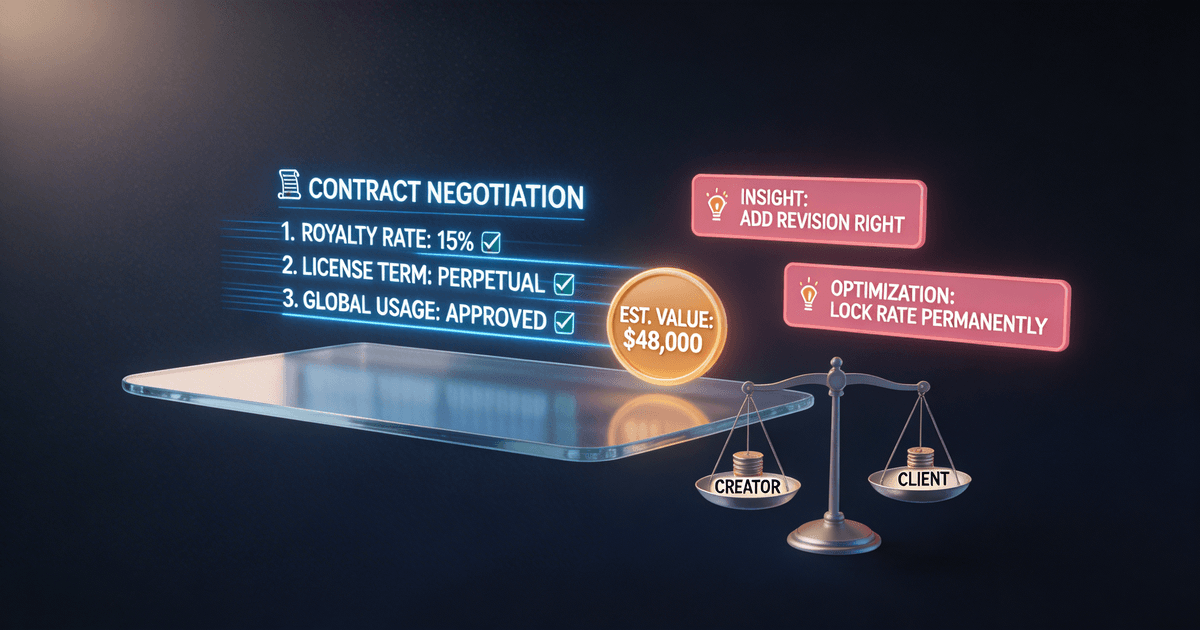
Most creators focus only on the dollar amount. Experienced negotiators know that deliverables, usage rights, and exclusivity matter just as much as the fee.
Usage rights: How long can they use your content? Where can they use it? Can they run it as a paid ad?
Standard: 1 year usage in organic social + website Premium: Unlimited usage across all channels including paid advertising
If they want usage beyond standard, that's worth 25-50% more.
Exclusivity: Can you work with competing brands? For how long?
A 6-month exclusivity clause that prevents you from working with any other fitness apps is worth significantly more than a deal with no exclusivity. Calculate how many potential deals you're giving up, and price accordingly.
Deliverables: What exactly are you creating?
- 60-second integration vs. 3-minute dedicated review
- 3 Instagram Stories vs. 1 feed post + Stories
- 1 TikTok video vs. a YouTube Short + TikTok + Reels
Be specific. Vague deliverables lead to revision hell.
Payment terms: When do you get paid?
Net 30 means they pay 30 days after you deliver. Net 15 is better. 50% upfront / 50% on delivery is better still. Full upfront for established creators with track records.
If they're paying late (Net 60+), charge a premium. Your time has value.
The Power of Walking Away
The best negotiation tactic is being willing to say no.
If a brand lowballs you, asks for too many deliverables, or demands unreasonable usage rights, you can walk away. This sounds scary when you're early in your career, but it's actually your biggest source of leverage.
Brands need creators more than creators need any single brand. There will be other deals. Taking a bad deal because you're afraid of losing it hurts you in three ways:
- You're underpaid for your time
- You're locked into unfavorable terms
- You're signaling to the market that you accept low rates
The creators who get paid well are the ones who decline low offers. Brands eventually learn that quality creators cost money.
That said, don't negotiate just to negotiate. If a brand offers your exact asking price with reasonable terms, accept it. Some creators feel like they must always get "more" and end up killing good deals by pushing too hard.
Know your must-haves vs. nice-to-haves. Fight for the must-haves. Be flexible on the nice-to-haves.
Handle Objections Like a Pro
Brands will push back. Here's how to handle common objections:
"Your rate is higher than our budget." "I understand budget constraints. Here's what I can deliver within your budget..." (Remove deliverables, don't lower your rate for the same work.)
"Other creators charge less." "They might, but here's what makes my integration different..." (Highlight your engagement rates, audience alignment, or past performance.)
"We don't pay creators; we do gifted collaborations." "I appreciate the offer, but I only accept paid partnerships. Here's my media kit if your budget opens up in the future."
"Can you lower your rate for long-term partnership potential?" "I'm open to discussing a multi-video rate, but my base rate reflects the value of this specific integration. Let's talk about what a longer-term partnership could look like."
"We need unlimited usage rights for our standard rate." "Unlimited usage beyond organic social requires additional licensing. Here's the rate for expanded usage rights..."
Never apologize for your rates. You don't say "I'm sorry, but I charge..." You say "My rate for this deliverable is..." Confidence signals that your pricing is justified.
Get It In Writing
Verbal agreements mean nothing. Email confirmations are slightly better. Contracts are what matter.
Before you create any sponsored content, you need:
- Signed contract outlining deliverables, timeline, payment terms, usage rights, and exclusivity
- Creative brief from the brand explaining messaging, talking points, and what success looks like
- Payment confirmation (at minimum, invoice sent; ideally, 50% deposit received)
Don't start work until the contract is signed. Brands that pressure you to "just get started" while contracts are "being processed" are setting you up for payment delays or scope creep.
If they won't sign a contract, they don't get content. Period.
Build Recurring Revenue, Not One-Off Deals
The creators who make real money from brand deals aren't constantly hunting for new sponsors. They've built recurring relationships with brands that pay them consistently.
After you complete a deal, follow up:
- Send performance metrics (views, engagement, click-through rates if available)
- Ask for feedback on the partnership
- Propose the next collaboration (quarterly series, seasonal campaign, etc.)
A brand that pays you $1,500 for one video is valuable. A brand that pays you $1,500 every quarter for a year is worth $6,000. The second type of relationship takes less work to maintain than constantly finding new sponsors.
Track which brands you've worked with, when, and what the results were. Reference these relationships in future negotiations: "I just completed a similar campaign with [Brand X] that generated 45,000 views and a 6% engagement rate."
When it's time to turn those results into a fresh pitch, Sponsor Outreach Email Writer helps you frame your audience fit and campaign results without sounding needy.
What to Do This Week
If you're serious about landing better brand deals, here's your action plan:
Monday: Calculate your baseline rate using CPM, time, and value methods. Know your numbers before anyone asks.
Tuesday: Create a simple media kit: your stats (subscribers, average views, engagement rate), audience demographics, past brand partners, and content examples. You don't need fancy design: clear information beats pretty graphics.
Wednesday: Audit your content for brand alignment. Which videos could naturally include a sponsor? What brands would fit your audience? Make a target list of 10 brands you'd love to work with.
Thursday: Review the Sponsor Deal Calculator skill. Input your specific numbers and get benchmarked rates for your niche and audience size. Use this data to build confidence in your pricing.
Friday: Practice your negotiation responses. Write out how you'd handle common objections. Role-play with a friend if possible. Negotiation is a skill: the more you practice, the better you get.
This month: If you have pending brand inquiries, apply these tactics. If not, start outreach to your target list. Many brands are open to sponsorships even when they're not actively seeking creators.
The Mindset Shift
Most creators think of themselves as content producers trying to monetize through brand deals.
Successful creators think of themselves as media companies selling access to a valuable audience.
Same person, different positioning. The first mindset begs for opportunities. The second mindset attracts them.
You're not lucky to get brand deals. Brands are lucky to get access to the audience you've built. Negotiate accordingly.
Ready to calculate your rates and negotiate better brand deals? The Sponsor Deal Calculator skill turns your AI into a sponsorship strategist. Input your numbers (subscribers, views, engagement, niche) and get benchmarked rates, deliverables pricing, and negotiation frameworks specifically for creator-brand partnerships.
Related reads:
About the author
Content, CreatorSkills
The CreatorSkills team publishes practical guides on AI workflows for content creators.
About CreatorSkills