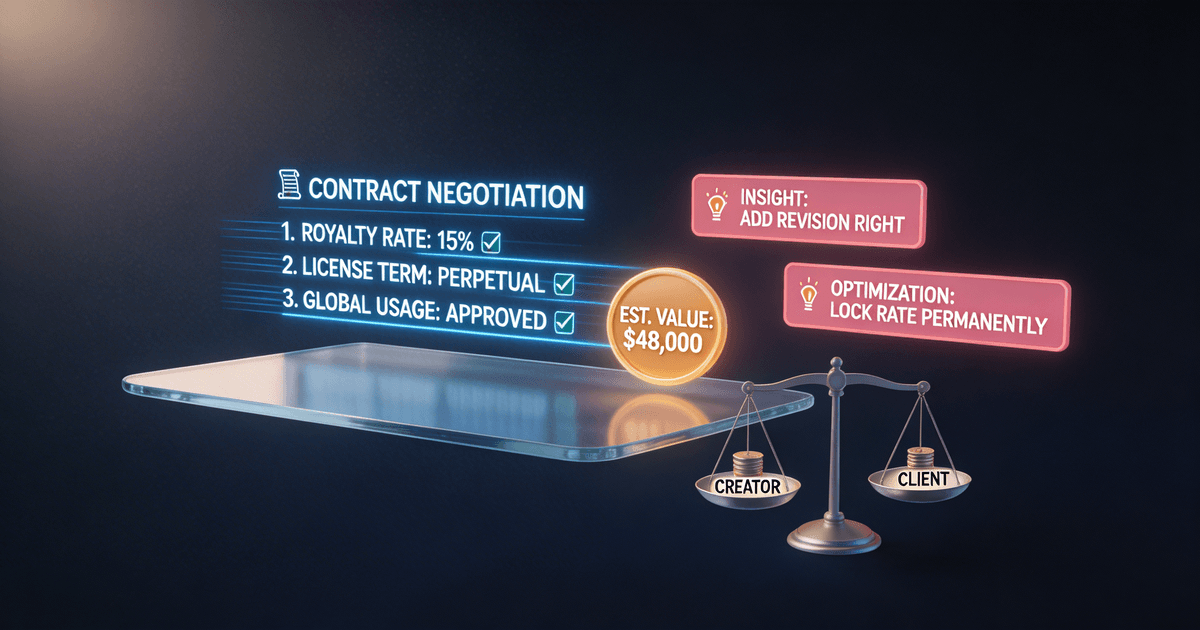
How to Use AI to Negotiate Better Brand Deals as a Creator
Most creators wing their brand deal negotiations: guessing at rates, writing generic pitches, and accepting the first offer. Here's how to use AI to price accurately, pitch professionally, and negotiate from a position of strength.
A brand emails you: "We love your content. What's your rate?"
You stare at the screen for 20 minutes, tab over to Google, search "how much should creators charge for sponsorships," find answers ranging from $100 to $50,000, and panic-reply with a number you half-made up.
Sound familiar? You're not alone. Most creators lose money on brand deals not because they lack talent, but because they negotiate without data. They guess at rates, send generic pitches, and accept the first offer because they're afraid to push back.
AI can fix every one of those problems. Not by negotiating for you, but by giving you the numbers, the language, and the strategy to negotiate from strength.
Here's the practical workflow.
Why most creator negotiations fail
Before the AI workflow, let's name the three places creators leave money on the table:
1. Pricing from vibes. You pick a number that "feels right" or match what a friend charged. But your friend has a different niche, different engagement, different audience demographics. Their rate has nothing to do with yours.
2. Pitching generically. Your outreach email says "I'd love to collaborate" without naming a specific product, proposing a concrete deliverable, or showing the brand what's in it for them. Brand managers get 50 of these a day.
3. Accepting the first offer. A brand says "$500 for a dedicated video." You don't know if that's fair, so you say yes. Turns out your channel's CPM puts your fair rate at $1,200. You just left $700 on the table, on one deal.
AI skills eliminate all three problems by replacing guesswork with data-backed calculations, personalized pitches, and negotiation frameworks.
Step 1: Calculate your actual rate (5 minutes)
The Sponsor Deal Calculator uses the same CPM model that brands use internally. You give it your numbers, it gives you a defensible rate.
What you input:
- Platform (YouTube, Instagram, TikTok, podcast, newsletter)
- Content type (integration, dedicated video, Reel, Story series)
- Average views per post (not follower count: brands care about reach, not vanity metrics)
- Your niche (finance, tech, beauty, gaming, lifestyle)
- Deliverables the brand is asking for
What you get back:
- A rate range (low, mid, high) based on current industry CPMs
- Niche-specific adjustments (a finance creator's audience is worth 1.5-2x more per impression than a lifestyle creator's)
- Add-on pricing for usage rights, exclusivity, whitelisting, and revision rounds
- A total package price you can quote with confidence
Example: A tech YouTuber averaging 25,000 views per video, asked for a 60-second integration:
| Component | Calculation | Amount |
|---|---|---|
| Base rate | 25K views x $25 mid-CPM | $625 |
| Tech niche multiplier | 1.5x | $937 |
| Usage rights (6 months) | +30% | $1,218 |
| One revision round | included | $0 |
| Total quote | $1,218 |
Now when the brand asks "what's your rate?" you don't guess. You say "$1,200 for a 60-second integration with 6 months of usage rights", and you can explain exactly how you got there.
Step 2: Write a pitch that gets a reply (10 minutes)
If you're reaching out to brands (instead of waiting for them to find you), your pitch email is everything. The Sponsor Outreach Email Writer builds emails that follow the structure brand managers actually respond to.
What makes AI-written pitches different from generic templates:
- Brand-specific hooks. The skill asks which brand you're targeting and why. It opens with a specific reference to their product or campaign, not "I love your brand" but "I saw you launched the X3 Pro last month, and my audience has been asking me to compare it to the competition."
- Concrete deliverables. Instead of "I'd love to collaborate," your pitch proposes a specific video concept, integration length, and timeline. Brands want to know exactly what they're buying.
- Social proof upfront. The skill structures your stats (views, engagement, audience demographics) as a value proposition, not a résumé. "My last 10 videos averaged 30K views with a 6.2% engagement rate, and 72% of my audience is 25-34" is a business case. "I have 50K subscribers" is not.
- Clear next step. Every pitch ends with a specific ask: "Would you be open to a 15-minute call this week?" Not a vague "let me know if you're interested."
Write 3-5 personalized outreach emails in the time it usually takes to agonize over one.
Step 3: Negotiate the actual deal (the human part)
AI handles the prep work. The negotiation itself is where your judgment matters. But AI prep changes how you show up.
When a brand lowballs you:
Instead of panicking or accepting, you check your calculator output and respond with data:
"Thanks for the offer. Based on my average reach of 25K views and tech niche CPMs, my standard rate for a 60-second integration is $1,200. I'd be happy to discuss adjusting deliverables to fit your budget, for example, a 30-second mention would be $750."
That response does three things:
- Shows you know your worth (they can't bluff you)
- Demonstrates professionalism (you're not emotional about it)
- Opens a negotiation (you're flexible but informed)
When a brand asks for extras:
Brands frequently add deliverables mid-negotiation: "Can you also post it as a Story?" or "We'd like 12 months of usage rights instead of 6."
Every extra has a price. Your rate calculator already accounts for add-ons:
- Usage rights extension (6 months → 12 months): +20-40% of base rate
- Additional platform post (Instagram Story, TikTok repost): +$200-500 depending on reach
- Exclusivity clause (can't work with competitors for 30-90 days): +25-50% of total deal
- Additional revision rounds: +$100-200 per round
When you can immediately price any request, you look like a professional who's done this before: even if it's your third deal ever.
When a brand ghosts after your quote:
Run the Sponsor Outreach Email Writer to draft a follow-up. The skill generates non-desperate follow-up sequences (one at 3 days, one at 7 days) that reference the original conversation and add a new angle or time-limited offer.
Common mistakes AI helps you avoid
Mistake 1: Pricing off follower count. Brands pay for views, not followers. The calculator uses average views per post, which is the metric that actually determines your ad value. A 100K-subscriber channel averaging 8K views is worth less per deal than a 30K-subscriber channel averaging 25K views.
Mistake 2: Forgetting to charge for usage rights. When a brand wants to use your content in their ads, that's a separate license. Most creators give this away for free because they don't know to charge for it. The calculator automatically adds usage rights pricing to your quote.
Mistake 3: Sending the same pitch to every brand. Template pitches get template responses (silence). The outreach writer forces you to input brand-specific context before it generates anything, so every email feels personalized, because it is.
Mistake 4: Not knowing your floor. Your floor is the lowest rate you'll accept before walking away. The calculator gives you low, mid, and high estimates. Use the low estimate as your absolute floor, the mid as your target, and the high as your opening ask. Now you have a negotiation range instead of a single desperate number.
The full AI-powered brand deal workflow
| Phase | Without AI | With AI skills |
|---|---|---|
| Rate calculation | Google + guesswork (30 min) | Sponsor Deal Calculator (5 min) |
| Outreach pitch | Stare at blank email (45 min) | Sponsor Outreach Email Writer (10 min) |
| Counter-offer prep | Panic, accept first offer | Check calculator, respond with data (5 min) |
| Follow-up | Send one awkward email, give up | Structured follow-up sequence (5 min) |
| Total prep time | ~2 hours (if you do it at all) | ~25 minutes |
The time savings matter, but the real value is confidence. When you walk into a negotiation knowing your numbers, your pitch sounds different. You're not asking for permission to be paid. You're proposing a business deal between equals.
Start negotiating smarter this week
Fair brand deals take data and preparation, and you can get them without a manager or an agency. Here's how to start:
- Run the Sponsor Deal Calculator with your current channel stats. Know your rate before any brand asks.
- Pick 3 brands that make sense for your niche. Use the Sponsor Outreach Email Writer to draft personalized pitches for each.
- Set your floor. Use the calculator's low estimate as your walk-away number. Don't accept deals below it: scarcity of supply is what drives your rates up over time.
- Track your results. Keep a simple spreadsheet: brand, initial offer, your counter, final deal, total revenue. After 5 deals, you'll see patterns in what works.
Browse more sponsorship and monetization tools in the Sponsor & Brand Deals category, or check out our guide on how to land brand deals as a creator in 2026 for the full pipeline from positioning to closing.
About the author
Editorial
Creator Skills helps content creators build AI-powered workflows that save time and grow audiences.
About CreatorSkills