How Small Creators Can Monetize AI Skills in 2026
You don't need a massive audience to make money with AI skills. Here's how small creators are turning AI workflows into income streams: even with fewer than 10,000 followers.
Most monetization advice assumes you already have 50,000 subscribers and brands lining up in your inbox. If that's you, great. But if you're a creator with 500, 2,000, or even 8,000 followers, that advice is useless.
Small creators can make money with AI without a big audience. It takes skills that let you do more with less, and the willingness to sell your output, not just your reach.
This guide is for creators who are still building their audience but want to start earning now. Not "someday when you hit 100K." Now.
Why small creators actually have an advantage with AI
Big creators have teams. They have editors, thumbnail designers, social media managers, and sponsorship agents. AI doesn't change their workflow much: it just shaves a few minutes off tasks their team already handles.
Small creators do everything themselves. That's where AI skills become a multiplier. When you're the writer, editor, designer, marketer, and accountant, saving 5 hours a week on content tasks is the difference between burnout and building a business.
And here's the part most people miss: the skills you build using AI are sellable, too. If you've figured out how to write YouTube scripts in 20 minutes using a long-form script system, other creators will pay you to do it for them.
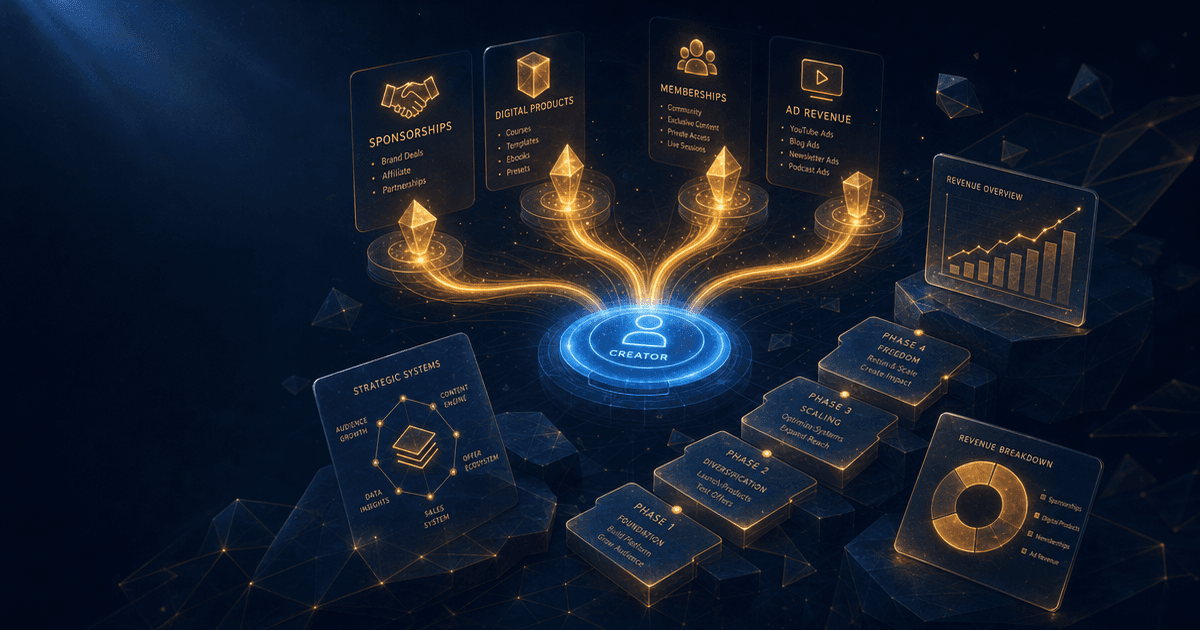
5 ways to monetize AI skills without a big following
1. Offer content services to other creators
The fastest path to income is serving someone who already has an audience.
Creators with 50K-500K subscribers are desperate for help with:
- Writing scripts and show notes
- Repurposing long-form content into social posts
- Managing community engagement
- Creating thumbnails and titles
- Building email sequences
You don't need to pitch yourself as a "social media manager." Position yourself as a content specialist who uses AI to deliver faster and more consistently than traditional freelancers.
What this looks like in practice:
A creator with a content repurposing workflow can take a single YouTube video and generate 10-15 social posts, a newsletter draft, and 3 blog outlines in under an hour. Offer that as a service for $200-500 per video, and you only need 4-8 clients per month to match a full-time income.
Use the Client Proposal System to write professional proposals that win these gigs without spending hours on each pitch.
2. Build and sell digital products
Digital products don't require a massive audience. They require a specific audience with a specific problem. And small creators often know their niche better than bigger ones because they're still close to the problems.
Products that sell well for small creators:
- Templates and workflows ($9-29): Content calendars, Notion dashboards, email sequences, thumbnail templates
- Mini-courses ($29-97): Focused on one skill, delivered as video or text
- Guides and playbooks ($19-49): Step-by-step processes for specific outcomes
- Self-published ebooks ($4.99-14.99): Niche guides on Amazon KDP: low barrier to entry, built-in marketplace, passive royalties
Amazon KDP is especially underused by small creators. Your niche knowledge translates directly into short, targeted ebooks that sell on autopilot. The free KDP self-publishing launch kit covers formatting, listing copy, and launch strategy so you can get your first ebook live without the typical weeks-long research phase.
AI skills speed up every step of product creation. Use the Course Curriculum Architect to outline a course in minutes instead of weeks. Use a script system to write your course content. Use a newsletter engine to promote it to your list.
The math for small audiences: If you have 2,000 email subscribers and 2% buy a $39 guide, that's $1,560 per launch. Launch quarterly, and you're earning $6,000+ per year from a "small" audience. Stack a second product and you've doubled it.
3. Monetize your content faster with strategic repurposing
Every piece of content you create has 5-10x more value locked inside it. Most small creators publish once and move on. Smart creators extract every possible asset.
One 15-minute YouTube video becomes:
- 3-5 short-form clips (YouTube Shorts, TikTok, Reels)
- 1 newsletter edition
- 5-8 social media posts
- 1 blog post (for SEO traffic)
- 1 community discussion thread
- Quote graphics for Pinterest and LinkedIn
More content means more surface area for discovery. More discovery means faster audience growth. Faster growth means more monetization options unlock sooner.
The Video to Everything Repurposer handles this entire workflow. Instead of spending 4 hours repurposing manually, you spend 30 minutes reviewing and tweaking AI-generated drafts.
If you're serious about this approach, our guide on how to automate content repurposing with AI walks through the full process.
4. Start with micro-sponsorships and affiliate content
You don't need 100K subscribers to work with brands. Companies with smaller budgets actively seek micro-creators (1K-10K followers) because:
- Higher engagement rates: small audiences are more engaged and trust the creator more
- Lower cost: brands can test with $100-500 instead of $5,000+
- Niche targeting: a 3,000-subscriber newsletter about productivity tools reaches exactly the audience a SaaS company wants
Use the Sponsor Deal Calculator to price your sponsorship slots fairly. Even at 5,000 subscribers, a newsletter sponsorship at $40 CPM (cost per thousand opens) with a 45% open rate earns $90 per slot. Run that weekly and it's $360/month, not life-changing, but it compounds.
Pair sponsorships with affiliate content. Write honest reviews of tools you actually use, include affiliate links, and let the content earn passively. AI skills help you produce more review content faster, which means more affiliate opportunities.
For a deeper look at negotiating with brands, check out our guide on how to land brand deals as a creator.
5. Sell your AI expertise directly
Here's the least obvious path: teach other creators how to use AI.
If you've spent weeks learning how to write great AI prompts, build workflows, and integrate skills into your content process, that knowledge has value. Other creators in your niche are still figuring it out.
Ways to sell your AI expertise:
- 1-on-1 setup sessions ($50-150/hour): Help creators install and customize AI skills for their specific workflow
- Group workshops ($19-49/person): Teach 10-20 creators how to use AI for their niche
- Custom skill configuration: Set up a creator's AI tools and workflows for a flat fee ($200-500)
- Community access ($5-15/month): A paid community where you share AI tips, new skills, and workflow updates
Being one step ahead of your audience, and willing to show them the path, is enough.
How to price your AI-powered services
The biggest mistake small creators make with AI services is pricing based on time instead of value. If AI helps you write a YouTube script in 20 minutes that used to take 2 hours, don't charge for 20 minutes of work. Charge for the script.
Value-based pricing framework:
- What would the client pay someone else to do this? (Market rate)
- How much time does this save the client? (Time value)
- What's the potential revenue impact? (Outcome value)
A YouTube script for a creator who earns $2,000 per video in ad revenue is worth $200-400: regardless of whether it took you 20 minutes or 2 hours to write.
The Monetization Strategy Planner helps you map out which revenue streams make sense for your specific situation, audience size, and niche. It's built to work for creators at every stage, not just the ones with massive followings.
Building your portfolio when you're just starting
No clients yet? No problem. Build proof by doing the work publicly.
- Document your own results. Track how AI skills affect your content output, quality, and growth. Share the numbers.
- Offer 2-3 free projects. Find creators in your niche and offer to repurpose one video or write one script for free. Use the results as case studies.
- Publish your process. Write about how you use AI in your workflow. This content attracts potential clients who want the same results.
- Collect testimonials early. Even from free projects. A quote from a creator saying "this saved me 5 hours" is worth more than any portfolio piece.
Our complete guide to AI skills for content creators covers the foundational workflows that make all of this possible.
Your 30-day monetization sprint
You don't need to do everything at once. Here's a focused plan:
Week 1: Foundation
- Pick 2-3 AI skills that match your niche (browse our full skill library)
- Set up your workflows and practice with your own content
- Document your before/after productivity numbers
Week 2: First offer
- Choose one service to offer (content repurposing is the easiest starting point)
- Write a simple service description and pricing
- Reach out to 5 creators in your niche with a free sample
Week 3: Build proof
- Complete your free projects and collect testimonials
- Publish a "how I use AI for content" post on your platform
- Start your first digital product outline
Week 4: Scale
- Convert free clients to paid
- Launch your first paid offer (service or product)
- Set up recurring content that attracts inbound leads
The bottom line
You can monetize as a small creator in 2026 right now, by using AI skills to deliver professional-quality work at a speed that makes your small audience irrelevant to your income.
The creators earning money right now figured out that AI skills turn a one-person operation into a one-person agency, and they're selling the output.
Start with one revenue stream. Get good at it. Then stack the next one.
Browse AI skills for creators and find the ones that fit your niche. Your audience size doesn't matter nearly as much as your willingness to start.
About the author
Founder, CreatorSkills
Caleb Leigh is the founder of CreatorSkills and helps creators build sustainable income through smart AI-powered workflows.
Read the founder profile