SEO Title & Description Writer: YouTube, Blog, and Podcast Titles That Actually Rank
Title and description copy is written last by most creators and written wrong by most others. The SEO Title & Description Writer for Claude and ChatGPT takes a topic, keyword, and platform and returns three title and description pairs per request, a recommended pick with reasoning, and quick SEO notes — following the specific character limits and search intent rules that actually determine whether your content gets found and clicked.
Most creators write their title last. After the video is edited, after the blog post is published, after the podcast is exported — they spend two minutes writing a title that feels "good enough" and hit publish.
That title is probably the thing most holding their content back.
The title and description aren't packaging for content — they are the content that decides whether anyone finds it. A video with a 4.8% CTR will grow ten times slower than the same video with an 8.3% CTR. A blog post with a generic title tag won't rank. A podcast episode with a vague title that doesn't include searchable terms won't surface in anyone's feed who isn't already looking for you specifically.
The SEO Title & Description Writer is a focused skill with one job: take your topic, target keyword, and platform, and return three title and description pairs optimized for the rules that actually govern whether content gets found and clicked.
What the Skill Produces
Every request returns the same format:
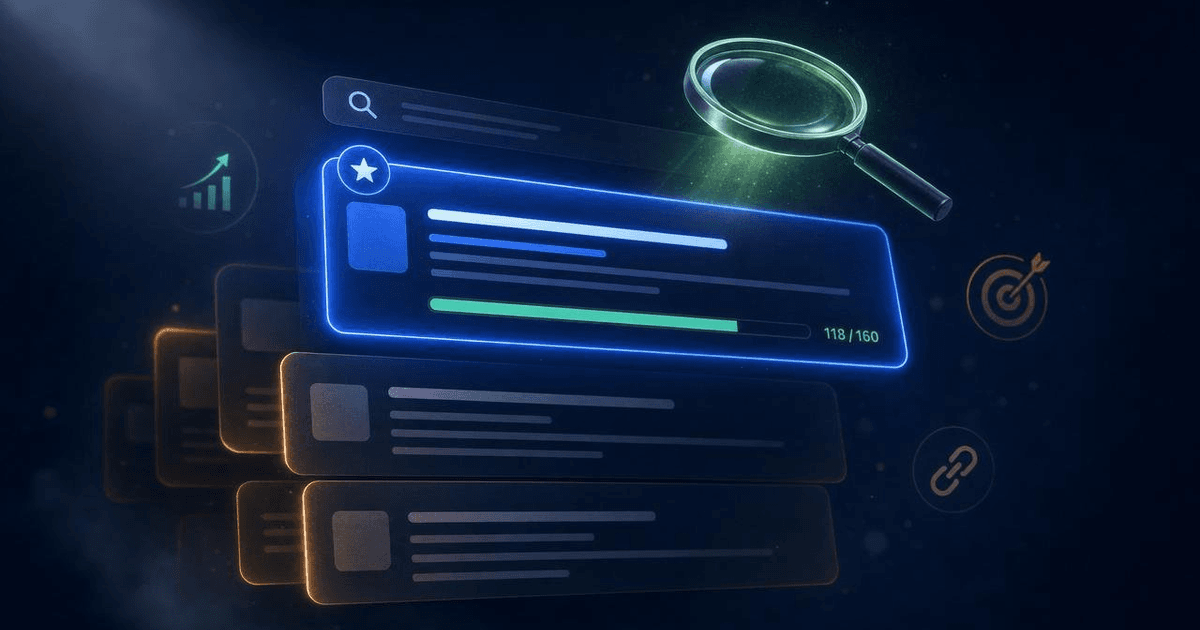
Three title and description pairs — Each pair includes the exact character count in parentheses so you know immediately whether it fits within the platform's limits. Each pair uses a different structural approach — one that front-loads the keyword, one that leads with the outcome, one that frames the angle differently — so you're comparing real options, not three versions of the same template.
A recommended pick — Two to three sentences explaining which option is strongest for the specific situation, factoring in keyword placement, intent match, the creator's niche, and what their audience is searching for. Not generic — specific to what was provided.
Quick SEO notes — Two to three actionable bullets with context specific to the keyword: related terms to use in the body content, internal linking angle, content format recommendations, or audience intent insights that affect how the title should be framed.
The whole output takes about 30 seconds and replaces what usually takes 20 minutes of second-guessing and A/B test-or-don't deliberation.
Platform Rules That Actually Matter
The skill applies platform-specific constraints that most title generators ignore.
YouTube — The hard limit is 100 characters, but titles truncate in search results around 60 characters, and on mobile the truncation happens at 40. The most important words go in the first 40 characters. Parenthetical modifiers work well and have consistent CTR data behind them: (2025), (HONEST Review), (Step-by-Step). Numbers in titles increase click-through rates — "5 Tips," "Top 7," "$500 Budget" all signal a specific payoff. The description's first 150 characters are what appears in search results — the skill writes that section for discoverability, not the full 5,000-character description body.
Blog posts — The title tag is 50-60 characters (Google truncates there). The H1 on the page can be longer, but the title tag is what shows in search results and what gets clicked. Meta descriptions are 150-155 characters. The meta description is a sales pitch for the article — it should complete the promise of the title and give searchers a reason to click your result over the nine others on the page. The primary keyword should appear once in the title and once in the description, where Google bolds it.
Podcast episodes — Apple Podcasts truncates around 60-65 characters in browse view. Spotify is similar. The opening sentence of the description is the only text most listeners see before deciding whether to click. Guest names boost discoverability directly ("with [Guest Name]" adds searchable terms). The skill generates both a version with an episode number and a version without — episode numbers help loyal listeners but hurt discoverability for new ones.
The Four Search Intent Types
The most common title mistake isn't a bad title — it's a title that doesn't match what the searcher actually wanted. Search intent mismatch kills CTR even when you rank.
Informational — The searcher wants to learn something. Keywords signal this: "how to," "what is," "why does," "guide," "tutorial." The title approach leads with a clear, specific knowledge promise: "How to Fix," "Complete Guide to," "Why Your X Is..." The searcher clicked because they want to understand something — the title needs to confirm that's what they'll get.
Commercial — The searcher is researching before buying. Signals: "best," "top," "review," "vs," "comparison," a year modifier. Title approach: promise a decision. "Best X for Y," "X vs Y," "Top 5 X in 2026." The searcher wants options compared, not one thing pushed.
Transactional — The searcher is ready to act. Signals: "buy," "download," "free," "template." Remove friction from the title. Make the action clear and immediate.
Navigational — The searcher is looking for a specific brand or page. Include the brand or product name prominently. This isn't the typical creator use case, but it matters for branded content and review videos.
The skill identifies the intent type before writing titles and flags if the keyword you're targeting doesn't match the content you're describing. A commercial-intent keyword ("best") in the title of a how-to tutorial will rank for the wrong searcher — and your CTR will suffer for it.
How to Use It: Step by Step
Minimal input:
YouTube video — best budget microphone for podcasting 2026
The skill picks the most natural keyword from the topic, tells you what it chose and why, generates three pairs with character counts, and recommends one.
Full brief:
Blog post comparing the Sony A7IV and Canon R6 Mark II for YouTube creators.
Target keyword: best camera for YouTube under $2000.
Audience: 25-40 year old YouTubers, intermediate level, upgrade from entry-level kit.
Main argument: the R6 II wins on autofocus, A7IV wins on video resolution.
Output with that context will be calibrated to the commercial intent, the specific price modifier, the audience level, and the comparative angle — not a generic review template.
Batch mode — run multiple pieces at once:
Generate SEO titles and descriptions for the following:

1. YouTube: beginner guide to color grading in DaVinci Resolve (keyword: color grading for beginners)
2. Blog: tutorial on growing an email list from YouTube (keyword: YouTube email list growth)
3. Podcast: episode on why most creators burn out at 100K subscribers
Three separate outputs, each following the right platform rules, returned in sequence.
The Clickbait Trap and Why Honest Titles Win Long-Term
The skill is explicit about one thing that most title generators skip: honesty rules exist for a practical reason, not an ethical one.
Google tracks CTR-to-dwell-time ratios. When someone clicks a title, watches 30 seconds, and leaves — Google registers that the title over-promised. Over time, over-promising titles get downranked even when they generate initial clicks. A manufactured-urgency title ("Watch This Before YouTube Deletes It") might spike CTR in week one and crater by week four.
The skill enforces this practically by flagging when a title claims more than the content delivers. "The Complete Guide to Everything" when the video covers one specific technique is the kind of mismatch it catches. Not because of a policy rule — because it will hurt the video's long-term performance.
Specific honest titles consistently outperform vague clickbait titles over a 90-day window. "How to Fix Audio Sync in Premiere Pro (3 Methods)" tells the searcher exactly what they'll learn and who it's for. It's competing against titles that try to be all things to everyone and end up being nothing to anyone.
Who Gets the Most Out of This Skill
Creators who publish across multiple platforms — One session can cover YouTube, blog, and podcast titles for the same piece of content, each formatted correctly for its platform. Thirty seconds per platform instead of three separate title-writing sessions.
Creators doing any SEO-driven content strategy — If any part of your content plan involves ranking in search (YouTube search, Google, Apple Podcasts), this is the skill that connects topic selection to title execution.
Creators who've never thought about character counts — Most creators have published video titles that truncated mid-word on mobile without knowing it. The character count in every output makes this invisible problem visible immediately.
Creators testing CTR improvements — The three-options format gives you real A/B test candidates, not just one "right answer." The recommended pick tells you where to start; the other two options are worth testing if the first doesn't perform.
Bloggers and writers — Title tags and meta descriptions for blog posts affect Google ranking directly. Most writers are strong at the content but weak at the packaging. This fills that gap.
Pricing and Where to Get It
The SEO Title & Description Writer is $7, one-time. Works in Claude and ChatGPT — load it once, use it every time you're publishing something that should be found.
→ Get the SEO Title & Description Writer
Pair It With
- YouTube SEO System — The title is one part of YouTube SEO. The YouTube SEO System handles keyword research, tags, chapter timing, and the full description body — everything that surrounds the title and description this skill writes.
- AI Title A/B Testing Framework — If CTR optimization is an active focus, the Title A/B Testing Framework generates and evaluates title variants with predicted performance reasoning before you test them.
- Analytics Translator — After publishing, the Analytics Translator interprets your Search CTR vs Browse CTR performance to tell you whether a title fix is actually needed — or whether the issue is somewhere else entirely.
The title is what gets clicked. The content is what gets watched. Most creators invest all their time in the second and almost none in the first — which is why most content doesn't grow. The SEO Title & Description Writer makes the first part fast.
About the author
Content, CreatorSkills
The CreatorSkills team publishes practical guides on AI workflows for content creators.
About CreatorSkills