Creator Affiliate Revenue System: Turn Recommendations Into Repeatable Income
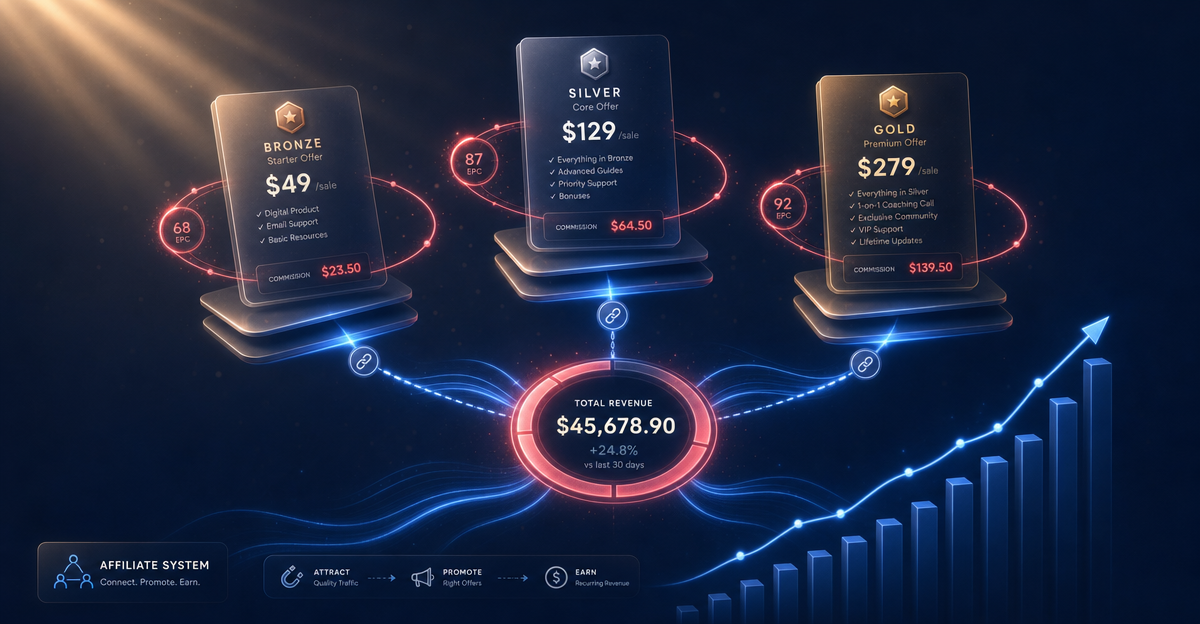
The Creator Affiliate Revenue System is a structured affiliate revenue workflow for creators who already recommend products in their content. It uses a 5-factor offer scoring framework (audience fit, creator conviction, payout quality, repeat mention potential, landing-page clarity) to filter offers into Primary, Secondary, and Experimental tiers. Channel mapping rules cover placement and CTA strategy for YouTube, newsletter, blog posts/resource pages, and podcasts. The system includes disclosure-safe CTA templates, a tracking dashboard with decision rules (high traffic / low clicks → placement problem; strong clicks / weak sales → offer problem), a quarterly refresh cadence, and a 30-day action sprint. Output format: full affiliate revenue system with offer stack, placement map, CTA bank, and tracking setup.
The gap between a creator who earns $200/month from affiliate links and one who earns $2,000/month isn't usually the number of links. It's the system — or lack of one.
The $200 creator drops links into video descriptions when they remember to, never revisits old content, has no way to tell which links are earning and which are dead weight, and treats affiliate income as a bonus rather than a managed revenue channel. The $2,000 creator knows exactly which content is driving clicks, which offers are converting, and which pages need a refresh before the next quarter.
The Creator Affiliate Revenue System builds the structure that turns the first creator into the second.
The Core Principle: Fewer Offers, Better Fit
The most common affiliate mistake is volume. A creator who signs up for 15 affiliate programs and scatters links across every piece of content doesn't out-earn a creator with 3 strong offers and a clear placement strategy — they underperform, because the audience senses the commission-grab before they trust the recommendation.
The system is built around the opposite approach: three strong offers beat ten scattered ones. Every recommendation needs to pass the honest test: would the creator recommend this if there were no commission?
The skill identifies this clearly. If a creator only wants a product because the commission is high, that offer gets rejected. If the creator would feel awkward disclosing the affiliate relationship, it gets rejected. Trust is the asset. Affiliate income is what trust produces when it's managed correctly.
The Offer Scoring Framework
Before building any placement strategy, the skill scores every potential affiliate offer on five factors:
Audience fit (1–5) — does the audience already ask about this problem or product category? A camera gear affiliate for a YouTube gaming channel might score a 2; for a filmmaking channel, it's a 5. The question isn't whether the product is good — it's whether the audience's buying intent is already pointed in that direction.
Creator conviction (1–5) — has the creator actually used it enough to recommend it honestly? Not "I've heard good things about it." Used it. Trust can only be transferred when it's genuine.
Payout quality (1–5) — this includes commission rate, cookie duration, recurring revenue potential (SaaS products that pay monthly commissions as long as the customer stays), and the minimum payout threshold. High commission on a product the audience won't buy is worth less than a modest commission on a product with strong audience fit.
Repeat mention potential (1–5) — can this product show up naturally in multiple pieces of content? An email marketing tool used in every newsletter discussion is worth more than a one-off product that fits only one video topic.
Landing-page clarity (1–5) — if people click, will the next step make sense immediately? A confusing or low-converting landing page kills affiliate performance regardless of how good the recommendation is.
The total score determines tier placement: Primary offer (highest score, featured in core content), Secondary offers (solid fit but not the main focus), Experimental offers (maximum 2, tested carefully before committing).
Channel Mapping
The right affiliate strategy differs significantly by platform. The skill maps each offer to the channels the creator actually uses, and provides format and placement guidance for each.
YouTube — the highest-leverage affiliate channel for most creators, because the intent is durable. A video from two years ago can still drive clicks today.
The best formats: full workflow or setup videos where the tool is part of the process, tutorials where the product is naturally demonstrated, comparison videos, buyer's guides, and "my stack" or resource videos. These create context for the recommendation rather than just announcing it.
Placement guidance: put the primary link high in the description, near the first relevant summary paragraph — not buried after timestamps. A pinned comment works when it adds genuine value (like a discount code or updated recommendation), not as a link dump. One primary CTA is almost always stronger than five; additional links belong only when they genuinely support the same use case.
Newsletter — high-intent, low-volume. Newsletter readers are self-selected to care about the creator's perspective, which makes affiliate recommendations land better than they do on social. The best approach is problem-first: name the problem the audience faces, then introduce the tool as the solution the creator uses.
A weekly tool spotlight or "what I'm using this week" section converts better than a standalone affiliate-only email, because it's positioned as a recommendation rather than a pitch. One featured affiliate section per issue typically outperforms multiple scattered links.
Blog posts and resource pages — the highest-leverage format for SEO-driven affiliate income. Tutorial posts, comparison articles, "best tools for X" pages, and creator setup pages can generate affiliate revenue for years without additional promotion.
Placement guidance: put links close to decision moments, not only at the bottom of a long post. Resource pages need refresh schedules — quarterly at minimum — because products change, pricing changes, and the creator's recommendations evolve.
Podcasts — host-read recommendations tied to episode topics outperform generic mid-roll mentions. When the recommendation connects to the episode's content ("we talked a lot about email marketing today — I've been using X for three years"), the click-through reflects genuine audience interest rather than passive listener behavior.
Disclosure and CTA Templates
Every affiliate system the skill builds includes disclosure-safe language. There's no gray zone here — the FTC requires disclosure, and burying it in the fourteenth line of a video description doesn't comply.
Effective disclosures are honest and simple:
- YouTube/blog: "Some links below are affiliate links, which means I may earn a commission if you buy through them at no extra cost to you. I only recommend tools I actually use."
- Newsletter: "Quick note: this link is affiliate-linked. I recommend it because I actually use it for [specific job]."
- Resource page: "Affiliate link. Included because it solves [specific problem] well."
The CTAs that convert are personal rather than promotional:
- "This is the tool I still use for [specific job]."
- "If you want the fastest way to [outcome], start here."
- "If you're deciding between the two, start with this one if your priority is [benefit]."
What doesn't work: fake urgency, vague "check it out" filler, overblown claims that make the audience skeptical, and copy that sounds like an ad pasted into creator content.
The Tracking and Refresh Loop
The difference between an affiliate side hustle and an affiliate revenue channel is measurement. The skill builds a tracking dashboard with these columns: offer, affiliate program, primary content asset, platform, link location, clicks, conversions (if available from the affiliate dashboard), revenue, earnings per click, last refreshed date, and next action.
The decision rules tell the creator what to do with the data:
High traffic, low clicks — the link placement or CTA is the problem. Move the link earlier in the description, sharpen the promise, or make the product's fit for the audience clearer.
Strong clicks, weak sales — either the offer is wrong for the audience, the landing page is weak, or the audience's buying intent doesn't match the product. Consider whether the offer belongs in the stack.
One asset drives most revenue — create adjacent content around the same buyer problem. If one "best editing software" video is generating most of the affiliate income, there are related videos (beginner vs. advanced, tutorial, comparison) that can extend the revenue without starting from scratch.
Zero clicks after enough exposure — remove, replace, or stop prioritizing that link. Stale links that go nowhere drag down the creator's mental model of what's working.
Old content still earns — refresh it before making new affiliate content. Updating the description, adding a pinned comment, or making minor changes to the video can extend the lifespan of high-performing content.
Quarterly is the minimum refresh cadence for evergreen resource pages and high-traffic affiliate content.
The 30-Day Action Sprint
The skill generates a week-by-week action plan for getting an affiliate system operational:
Week 1 — audit existing content for affiliate retrofit opportunities. Identify the top 5 pieces of content that still get traffic and don't have affiliate links (or have weak ones). Update descriptions, add pinned comments, and set up tracking.
Week 2 — finalize the offer stack. Score every potential offer, identify the primary and secondary offers, and join or confirm programs for each.
Week 3 — create one piece of content specifically designed to feature the primary offer. Workflow video, tutorial, setup guide, or comparison — whatever format fits the niche.
Week 4 — set up the tracking dashboard and schedule the first quarterly review. Affiliate income compounds when it's measured and maintained.
What the System Produces
The output from the Creator Affiliate Revenue System is a complete affiliate package: current position assessment, recommended offer stack with reasoning, a list of existing content to update first, a new content and placement map by channel, a CTA and disclosure bank with ready-to-use copy, a tracking dashboard structure, decision rules for each performance scenario, and the 30-day action sprint.
How to Use It
Describe your niche, the platforms you publish on, the products and tools you already use or recommend, any existing affiliate programs you're part of, and which content assets are already getting traffic. The skill builds the system from there — offer scoring, placement map, CTAs, and tracking setup.
Pricing and Where to Get It
The Creator Affiliate Revenue System is $7, one-time. Works in Claude and ChatGPT — describe your content and the products you already recommend, get back a complete affiliate revenue system with offer stack, placement map, and tracking setup.
→ Get the Creator Affiliate Revenue System
Pair It With
- Sponsor Deal Calculator — For creators who want to compare affiliate income against direct brand partnerships, the Calculator prices sponsorships based on audience size and engagement, making it possible to evaluate which revenue model is worth prioritizing at a given stage.
- Video to Everything Repurposer — The most effective affiliate content repurposes high-performing videos into newsletters, blog posts, and resource pages that each carry affiliate links. The Repurposer handles the transformation from one format to many.
- Newsletter Conversion Engine — For creators who want affiliate links to convert better in email, the Conversion Engine optimizes CTR, subject lines, and the structural elements that determine whether newsletter readers click.
Affiliate income doesn't come from having more links — it comes from having the right links in the right places with the right context. The system makes that distinction explicit, measurable, and actionable rather than leaving it to chance.
About the author
Content, CreatorSkills
The CreatorSkills team publishes practical guides on AI workflows for content creators.
About CreatorSkills